Land in sight

“Land was in sight to the east and south about sixteen miles distant on the 22nd. The land-ice seemed to be faced with ice-cliffs at most points, but here and there slopes ran down to sea-level. Large crevassed areas in terraces parallel with the coast showed where the ice was moving down over foot-hills. The inland ice appeared for the most part to be undulating, smooth, and easy to march over, but many crevasses might have been concealed from us by the surface snow or by the absence of shadows. I thought that the land probably rose to a height of 5000 ft. forty or fifty miles inland. The accurate estimation of heights and distances in the Antarctic is always difficult, owing to the clear air, the confusing monotony of colouring, and the deceptive effect of mirage and refraction. The land appeared to increase in height to the southward, where we saw a line of land or barrier that must have been seventy miles, and possibly was even more distant.”

— Ernest Shackleton, 22 January 1915, South

Posted in Shackleton | Comments Off on Land in sight

“Morrell’s Land”

New_South_Greenland_Map

“New South Greenland, sometimes known as Morrell’s Land, was an appearance of land recorded by the American captain Benjamin Morrell of the schooner Wasp in March 1823, during a sealing and exploration voyage in the Weddell Sea area of Antarctica. Morrell provided precise coordinates and a description of a coastline which he claimed to have sailed along for more than 300 miles (480 km). Because the Weddell Sea area was so little visited, and hard to navigate due to ice conditions, the alleged land was never properly investigated before its existence was emphatically disproved during Antarctic expeditions in the early 20th century.

“At the time of Morrell’s voyage, the geography of the then unnamed Weddell Sea and its surrounding coasts was almost entirely unknown, making the claimed sighting initially plausible. However, obvious errors in Morrell’s voyage account, and his general reputation as a fabulist, created scepticism about the existence of this new land. In June 1912 the German explorer Wilhelm Filchner searched for but found no traces of land, after his ship Deutschland became icebound in the Weddell Sea and drifted into the locality of Morrell’s observation. A sounding of the sea bottom revealed more than 5,000 feet (1,500 m) of water, indicating no land in near proximity. Three years later, trapped in the same waters with his ship Endurance, Ernest Shackleton was able by similar means to confirm the land’s non-existence.”

— text and map: wikipedia

Posted in Images, Other Voices | Comments Off on “Morrell’s Land”

“Infallible”

“A wretched day. Blowing a blizzard—wind and snow. Unable to move. We are very much stuck in the pack. There is ice all round us, even under the stern, and no open water alongside the ship at all, as there usually is, but as the temperature is high, 29deg, there is no fear at present of our getting frozen in.”

“Sir Ernest seems to know just what the ice is going to do every time and so far he has been infallible. He is ready to attempt anything and yet if the ship gets into a position involving the remotest possibility of peril, he is unremitting in his attention to her navigation until she is removed from every vestige of prospective danger.”

— Thomas Orde-Lees, 20 January 1915

Posted in Other Voices | Comments Off on “Infallible”

Closed around the ship like pudding

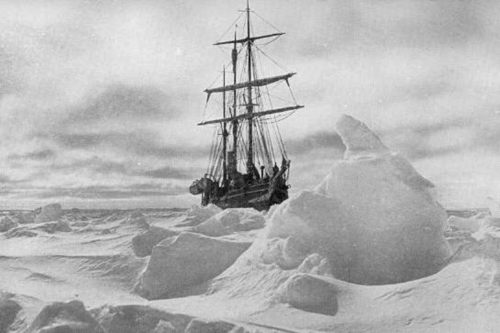
“Almost immediately they realized that this was a different sort of ice from anything encountered before. The floes were thick but very soft, and consisted mostly of snow. They floated in a soupy sea of mushy brash ice composed of ground-up floes and lumps of snow. The mass of it closed in around the ship like pudding.”

— Alfred Lansing, Endurance

Posted in Other Voices | Comments Off on Closed around the ship like pudding

It is now seven weeks…

“It is now seven weeks since we first entered the pack ice and since then it has been almost an incessant battle. It is gratifying to feel we are only 80 miles from… Vahsel Bay. We are all keen to reach it as the monotony is telling on some of us.”

— Frank Hurley

Posted in Other Voices | Comments Off on It is now seven weeks…

His Natural Life

origfortheterm1.jpg.350.0x258.125_q100

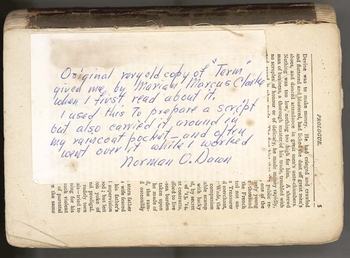
Copy of (For the Term of) His Natural Life, by Marcus Clarke, publ. 1874*

“[This] novel is considered one of the first examples of Tasmanian Gothic literature. [Read on gutenberg.org.]

“The original tragic ending was considered unsuitable for readers in the US, as a result of which Marcus Clarke added additional chapters taking the story up to the Victorian gold rush for US editions. Most modern publications and film media presentations of the story have been based on the US edition.

“The story was meant as an alchemical allegory. Clarke had studied the industrial production of diamonds, in which an essential stage of ugly blackness precedes the beauty of the diamond’s crystallisation.

“Eventually, the novel became known as For the Term of His Natural Life but, originally, Clarke wanted the shorter title to suggest that this story was about the universal human struggle and the future Australian race. He wanted to celebrate the survival of the human spirit in the direst circumstances. With its cruelty and systemic violence, this book, more than any other, has come to define the Australian convict past.” — wikipedia; image: NFSA, Australia

* In 1926, [the actress] Marion Marcus Clarke gave an early edition of the classic Australian novel For the Term of His Natural Life to American director Norman Dawn, who was about to make Australia’s third film adaptation of the book. Marion Marcus Clarke, besides playing mother to the hero of this film, was a daughter of the author, Marcus Clarke (1846-1881).Graham Shirley, NFSA Historian]

Posted in Images, Other Voices, Video | Comments Off on His Natural Life

Evil Conditions

jigsaw3

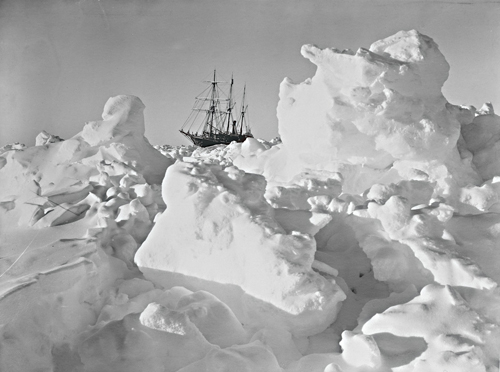
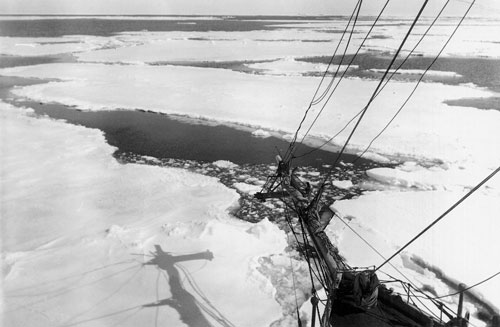
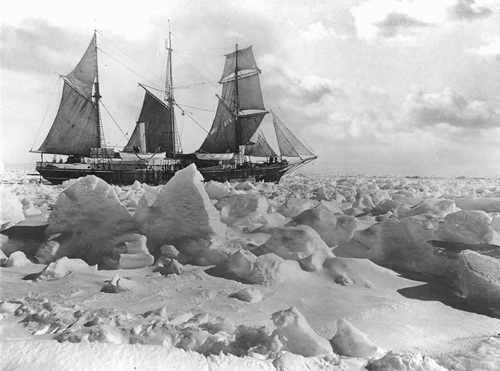
“I had been prepared for evil conditions in the Weddell Sea, but had hoped that in December and January, at any rate, the pack would be loose, even if no open water was to be found. What we were actually encountering was a fairly dense pack of a very obstinate character. Pack ice might be described as a gigantic and interminable jigsaw puzzle devised by Nature. The parts of the puzzle in loose pack have floated slightly apart and become disarranged; at numerous places they have pressed together again; as the pack gets close the congested areas grow larger and the parts are jammed harder til finally it becomes “close pack,” when the whole of the jigsaw puzzle becomes jammed to such an extent that with care and labor it can be traversed in every direction on foot. Where the parts do not fit closely there is, of course, open water, which freezes over in a few hours after giving off volumes of “frost-smoke.”

jigsaw1

In obedience to renewed pressure this young ice “rafts,” so forming double thicknesses of a toffeelike consistency. Again the opposing edges of heavy floes rear up in slow and almost silent conflict, till high “hedgerows” are formed round each part of the puzzle. At the junction of several floes chaotic areas of piled-up blocks and masses of ice are formed. Sometimes 5-ft to 6t-ft piles of evenly shaped blocks of ice are seen so neatly laid that it seems impossible for them to be Nature’s work. Again, a winding canyon may be traversed between icy walls 6 f to 10 ft high, or a dome may be formed that under renewed pressure bursts upward like a volcano. All through the winter the drifting pack changes — grows by freezing, thickens by rafting, and corrugates by pressure. If, finally, in its drift it impinges upon a coast, such as the western short of the Weddell Sea, terrific pressure is set up and an inferno of ice blocks, ridges, and hedgerows result, extending possibly for 150 or 200 miles off shore. Sections of pressure ice may drift away subsequently and become embedded in new ice.”
jigsaw2

“Another point that may require to be explained was the delay caused by wind while we were in the pack. When a strong breeze or moderate gale was blowing the ship could not safely work through any except young ice, up to about 2 feet in thickness. As ice of that nature never extended more than a mile or so, it followed that in a gale in the pack we always had to lie to.”

— Ernest Shackleton, South

Posted in Shackleton | Comments Off on Evil Conditions

Caird Coast

cairdcoast

“The Brunt Ice Shelf, visible here, borders the Antarctic coast of Coats Land, Antarctica, between the Dawson-Lambton Glacier and the Stancomb-Wills Glacier Tongue. The Brunt Icefalls extend along Caird Coast, a portion of the shore of Coats Land, for about 80 km (50 mi), where the steep and jagged ice-covered coast descends to Brunt Ice Shelf.”

— Earth Snapshot [link]

Posted in Images, Other Voices | Comments Off on Caird Coast

Ramming

“During the weeks we spent manoeuvring to the south through the tortuous mazes of the pack it was necessary often to split floes by driving the ship against them. This form of attack was effective against ice up to three feet in thickness, and the process is interesting enough to be worth describing briefly. When the way was barred by a floe of moderate thickness we would drive the ship at half speed against it, stopping the engines just before the impact. At the first blow the Endurance would cut a V-shaped nick in the face of the floe, the slope of her cutwater often causing her bows to rise till nearly clear of the water, when she would slide backwards, rolling slightly. Watching carefully that loose lumps of ice did not damage the propeller, we would reverse the engines and back the ship off 200 to 300 yards. She would then be driven full speed into the V, taking care to hit the center accurately. The operation would be repeated until a short dock was cut, into which the ship, acting as a large wedge, was driven. At about the fourth attempt, if it was to succeed at all, the floe would yield. A black, sinuous line, as though pen-drawn on white paper, would appear ahead, boradening as the eye traced it back to the ship. Presently it would be broad enough to receive her, and we would forge ahead. Under the bows and alongside, great slabs of ice were being turned over and slid back on the floe, or driven down and under the ice and ship. In this way the Endurance would split a 2-ft. to 3-ft. floe a square mile in extent. Occasionally the floe, although cracked across, would be so held by other floes that it would refuse to open wide, and so gradually would bring the ship to a standstill. We would then go astern for some distance and again drive her full speed into the crack, till finally the floe would yield to the repeated onslaughts.”

— Ernest Shackleton, South

Posted in Images, Shackleton | Comments Off on Ramming

Worsley specialized in ramming

“Each watch had its characteristics. Worsley specialised in ramming, and I have a sneaking suspicion that he often went out of his way to find a nice piece of floe at which he could drive at full speed and cut in two; he loved to feel the shock, the riding up, and the sensation, as the ice gave and we drove through.”

— Alexander Macklin

Posted in Other Voices | Comments Off on Worsley specialized in ramming