Should a visitor arrive at midnight

camp-twoigloos

“[Should a visitor arrive at midnight…] he would notice that… it was still light, the sun never setting at this time of year in this latitude. He would have to pass a line of dogs tethered in teams to wires… secured at one end to their own loaded sledges and at the other to an iron stanchion driven deeply in the snow. The sledge trace is in position and the harnesses all secured in place and ready to be put on the dogs… The sledges are loaded and lashed…everything ready to be moved at a moment’s notice.

“At sight of the visitor, the dogs set up a furious barking… The night watchman… greets the visitor, and shows him the general arrangement of the camp:

“The gallery, so called, is a canvas structure made from the ship’s sails and spars. Inside… is the stove… In the same ‘galley’ is the little library…saved from the ship. Here also Marston does his cobbling, Hurley makes his self-devised apparatus etc. etc. There is also in here a chronometer giving the local time, and of all things in the world, a looking glass.”

— Alexander Macklin

Posted in Images, Other Voices | Comments Off on Should a visitor arrive at midnight

“Marmion”

“I do not rhyme to that dull elf,
Who cannot image to himself”

— Sir Walter Scott, Marmion

marmion_fancycover

“When it came Greenstreet’s turn, he elected to read Sir Walter Scott’s Marmion.”

— Alfred Lansing, Endurance

“I must confess I find his reading an excellent soporific.”

— Alexander Macklin

Posted in Images, Other Voices | Comments Off on “Marmion”

“Science from an Easy Chair”

scienceeasychair

“In order to know very minutely the differences and resemblances between all the kinds or species of one group of living things Darwin studied for eight years the “cirrhipedes,” the name give to the sea-acorns and ships’ barnacles which occur in all parts of the world, some living on rocks, some on the backs of turtles, others on whales, on the feet of birds, on bits of floating wood or of pumice-stone, and some on one another! They are all hermaphrodites, but Darwin found in several a most singular thing, namely, the existence of minute males, complemental to and parasitic on the hermaphrodites. His discovery was doubted and denied, but he had the pleasure of seeing it at last fully confirmed thirty years after his book on cirrhipedes was published.”

-from Science from an Easy Chair, by Sir E. Ray Lankester, 1910, pp. 23-4.

Posted in Images, Other Voices | Comments Off on “Science from an Easy Chair”

On the Sea

On the Sea

It keeps eternal whisperings around
Desolate shores, and with its mighty swell
Gluts twice ten thousand Caverns, till the spell
Of Hecate leaves them their old shadowy sound.
Often ’tis in such gentle temper found,
That scarcely will the very smallest shell
Be moved for days from where it sometime fell.
When last the winds of Heaven were unbound.
Oh, ye! who have your eyeballs vexed and tired,
Feast them upon the wideness of the Sea;
Oh ye! whose ears are dinned with uproar rude,
Or fed too much with cloying melody—
Sit ye near some old Cavern’s Mouth and brood,
Until ye start, as if the sea nymphs quired!

by John Keats

Posted in Other Voices | Comments Off on On the Sea

Over The Sea Our Galleys Went

Over The Sea Our Galleys Went

Over the sea our galleys went,
With cleaving prows in order brave,
To a speeding wind and a bounding wave,

A gallant armament:
Each bark built out of a forest-tree,

Left leafy and rough as first it grew,
And nailed all over the gaping sides,
Within and without, with black bull-hides,
Seethed in fat and suppled in flame,
To bear the playful billows’ game:
So, each good ship was rude to see,
Rude and bare to the outward view,

But each upbore a stately tent
Where cedar-pales in scented row
Kept out the flakes of the dancing brine,
And an awning drooped the mast below,
In fold on fold of the purple fine,
That neither noontide nor star-shine
Nor moonlight cold which maketh mad,

Might pierce the regal tenement.
When the sun dawned, oh, gay and glad
We set the sail and plied the oar;
But when the night-wind blew like breath,
For joy of one day’s voyage more,
We sang together on the wide sea,
Like men at peace on a peaceful shore;
Each sail was loosed to the wind so free,
Each helm made sure by the twilight star,
And in a sleep as calm as death,
We, the voyagers from afar,

Lay stretched along, each weary crew
In a circle round its wondrous tent
Whence gleamed soft light and curled rich scent,

And with light and perfume, music too:
So the stars wheeled round, and the darkness past,
And at morn we started beside the mast,
And still each ship was sailing fast!

Now, one morn, land appeared! — a speck
Dim trembling betwixt sea and sky:
‘Avoid it,’ cried our pilot, ‘check

The shout, restrain the eager eye! ‘
But the heaving sea was black behind
For many a night and many a day,
And land, though but a rock, drew nigh;
So, we broke the cedar pales away,
Let the purple awning flap in the wind,

And a statue bright was on every deck!
We shouted, every man of us,
And steered right into the harbour thus,
With pomp and paean glorious.
A hundred shapes of lucid stone!

All day we built its shrine for each,
A shrine of rock for every one,
Nor paused we till in the westering sun

We sat together on the beach
To sing because our task was done.
When lo! what shouts and merry songs!
What laughter all the distance stirs!
A loaded raft with happy throngs
Of gentle islanders!
‘Our isles are just at hand,’ they cried,

‘Like cloudlets faint in even sleeping;
Our temple-gates are opened wide,

Our olive-groves thick shade are keeping
For these majestic forms’— they cried.
Oh, then we awoke with sudden start
From our deep dream, and knew, too late,
How bare the rock, how desolate,
Which had received our precious freight:

Yet we called out— ‘Depart!
Our gifts, once given, must here abide.

Our work is done; we have no heart
To mar our work,’— we cried.

Robert Browning

Posted in Other Voices | Comments Off on Over The Sea Our Galleys Went

The “vitamin”

Vitamines-Essential-Food-Factors

“Shackleton, who was rather an amazing man in the way he had made himself au fait with all the latest developments… and who had [also] collected all the latest information as regards scurvy, was very enthusiastic [about] the idea of the “vitamin.” During our discussions on the Endurance, Shackleton used to say to me, ‘surely you have here the perfect explanation for all that has been puzzling you?'”

“I discussed the problem very earnestly with my tent mates, a conglomerate lot. Someone asked why seals and penguins did not get scurvy and suggested that as they did not and humans did there must be something in their make up which prevented it. This gave us the idea that if we ate all of the seal and the penguin including the brain, heart, liver, kidney and sweetbread…this might help to avoid scurvy.”

— Alexander Macklin

“They had stumbled on the truth: the brain, heart and kidneys of the seal are potent sources of vitamin C. The camp on the ice floe…was probably the only place in the world where the vitamin theory, as it were, had become official orthodoxy.”

— Roland Huntford, Shackleton

Posted in Images, Other Voices | Comments Off on The “vitamin”

Ratcliffe Highway (2)

Ratcliffe Highway performed by The Dubliners

Posted in Video | Comments Off on Ratcliffe Highway (2)

Ratcliffe Highway (1)

RatcliffeHighwayMurders-Map1811-lores9-600x430

“One would imagine he is in Ratcliffe Highway or some other den by the language that is being used. I have been shipmates with all sorts of men both in sail and steam, but never nothing like some of our party – as the most filthy language is used as terms of endearment, and, worse of all, is tolerated.”

— Harry McNeish

Posted in Images, Other Voices | Comments Off on Ratcliffe Highway (1)

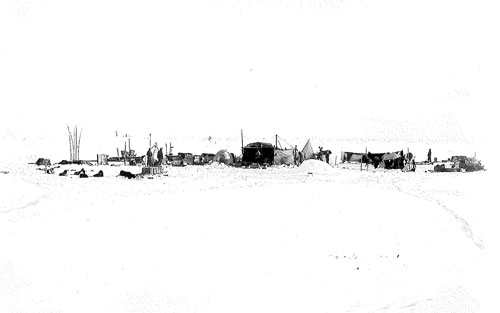
Our perambulations are now very circumscribed

camp_distantview

“The floe is completely surrounded by water except at one or two points, and so exercise, where risks are unnecessary, is limited to running round and round the floe…”

— Alexander Macklin

“Our perambulations are now very circumscribed as the floe has wide cracks all around it. These can of course be crossed at many places, as they are mostly filled with broken lumps of ice and rubble, but unless occasion actually demands it, it is prudent not to leave the floe for the cracks are continually working and where one crossed over in safety one minute may be open water and quite impassable the next. By a long detour one would always manage to get back, as far as our experience goes, but it entails anxiety, often a partial ducking, and the time occupied may be so much as to cause one to be reported as missing from camp.”

— Thomas Orde-Lees

Posted in Images, Other Voices | Comments Off on Our perambulations are now very circumscribed

The James Caird

The James Caird

The James Caird

“The sledge [was] a great success and its solid construction does the carpenter credit, horrid old man that he is. Now he is raising the gunwale of the James Caird some 10in by the extraordinary expedient of fixing its existing gunwale the upper part of the gunwale of the now derelict motor boat. He certainly is a brilliant workman.”

— Thomas Orde-Lees

“Her planking was Baltic pine, keel & timbers American elm & stem & sternpost English oak.”

— Frank Worsley

McNeish put chafing battens on the James Caird’s bow: “…to keep the young ice from cutting through as she is built of white pine which wont last long in ice.”

— Chippy McNeish

“In lieu of the usual caulking materials—oakum and pitch—McNeish had filled the seams with lamp wick and sealed them over with Marston’s oil paints. The nails he used had been extracted from salvaged timber of the Endurance.”

— Caroline Alexander

jamescaird
Posted in Images, Other Voices | Comments Off on The James Caird