Ice cliffs, Coats Land

[The ice cliffs of Coats’ Land, Antarctica, eastern edge of the Weddell Sea. Named by William S. Bruce, Scottish National Antarctic Expedition, 1902.]

“We were now in the vicinity of the land discovered by Dr. W. S. Bruce, leader of the Scotia Expedition, in 1904, and named by him Coats’ Land. Dr. Bruce encountered an ice-barrier in lat. 72° 18´ S., long. 10° W., stretching from north-east to south-west. He followed the barrier-edge to the south-west for 150 miles and reached lat. 74° 1´ S., long. 22° W. He saw no naked rock, but his description of rising slopes of snow and ice, with shoaling water off the barrier-wall, indicated clearly the presence of land. It was up those slopes, at a point as far south as possible, that I planned to begin the march across the Antarctic continent. All hands were watching now for the coast described by Dr. Bruce, and at 5 p.m. the look-out reported an appearance of land to the south-south-east. We could see a gentle snow-slope rising to a height of about one thousand feet. It seemed to be an island or a peninsula with a sound on its south side, and the position of its most northerly point was about 72° 34´ S., 16° 40´ W. The Endurance was passing through heavy loose pack, and shortly before midnight she broke into a lead of open sea along a barrier-edge. A sounding within one cable’s length of the barrier-edge gave no bottom with 210 fathoms of line. The barrier was 70 ft. high, with cliffs of about 40 ft. The Scotia must have passed this point when pushing to Bruce’s farthest south on March 6, 1904, and I knew from the narrative of that voyage, as well as from our own observation, that the coast trended away to the south-west. The lead of open water continued along the barrier-edge, and we pushed forward without delay.”

— Ernest Shackleton, South

Posted in Images, Shackleton | Comments Off on Ice cliffs, Coats Land

On first looking into Chapman’s Homer

On first looking into Chapman’s Homer

MUCH have I travell’d in the realms of gold,
And many goodly states and kingdoms seen;
Round many western islands have I been
Which bards in fealty to Apollo hold.
Oft of one wide expanse had I been told
That deep-brow’d Homer ruled as his demesne;
Yet did I never breathe its pure serene
Till I heard Chapman speak out loud and bold:
Then felt I like some watcher of the skies
When a new planet swims into his ken;
Or like stout Cortez when with eagle eyes
He star’d at the Pacific—and all his men
Look’d at each other with a wild surmise—
Silent, upon a peak in Darien.

John Keats, 1816

Posted in Other Voices | Comments Off on On first looking into Chapman’s Homer

Letting the dogs out

dogs_walking

“There was some open water north of the floe, but as the day was calm and I did not wish to use coal in a possibly vain search for an opening to the southward, I kept the ship moored to the floe. This pause in good weather gave an opportunity to exercise the dogs, which were taken on to the floe by the men in charge of them. The excitement of the animals was intense. Several managed to get into the water, and the muzzles they were wearing did not prevent some hot fights. Two dogs which had contrived to slip their muzzles fought themselves into an icy pool and were hauled out still locked in a grapple. However, men and dogs enjoyed the exercise.”

— Ernest Shackleton, South

Posted in Images, Shackleton | Comments Off on Letting the dogs out

A fine cunieform mass

berg

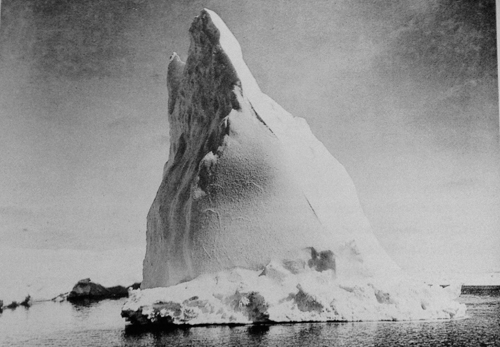
“At 10:00 a.m. we entered long leads of ice free water, in which were drifting some fine bergs of magnificent forms. One a fine cuneiform mass 200 feet high, I photographed.”

— Frank Hurley

Posted in Images, Other Voices | Comments Off on A fine cunieform mass

Leopard Seal – National Geographic

National Geographic photographer Paul Nicklen meets a leopard seal.

Posted in Video | Comments Off on Leopard Seal – National Geographic

No doubt the explorers of 2015…

“I do so wish sometimes, that I could just pop home for an hour or two as easily in the flesh as in the spirit. No doubt the explorers of 2015, if there is anything left to explore, will not only carry their pocket wireless telephones fitted with wireless telescopes but will also receive their nourishment & warmth by wireless… and also their power to drive their motor sledges, but, of course, there will be an aerial daily excursion to both poles then, & it will be the bottom of the Atlantic, if not the centre of the earth that will form the goal in those days.”

— Thomas Orde-Lees

Posted in Other Voices | Comments Off on No doubt the explorers of 2015…

New Years 1915

newyears1915

“The ship had a serious encounter with the ice on the morning of December 31. We were stopped first by floes closing around us, and then about noon the Endurance got jammed between two floes heading east-north-east. The pressure heeled the ship over six degrees while we were getting an ice-anchor on to the floe in order to heave astern and thus assist the engines, which were running at full speed. The effort was successful. Immediately afterwards, at the spot where the Endurance had been held, slabs of ice 50 ft. by 15 ft. and 4 ft. thick were forced ten or twelve feet up on the lee floe at an angle of 45°. The pressure was severe, and we were not sorry to have the ship out of its reach. The noon position was lat. 66° 47´ S., long. 15° 52´ W., and the run for the preceding twenty-four hours was 51 miles S. 29° E.
 
“Since noon the character of the pack has improved,” wrote Worsley on this day. “Though the leads are short, the floes are rotten and easily broken through if a good place is selected with care and judgment. In many cases we find large sheets of young ice through which the ship cuts for a mile or two miles at a stretch. I have been conning and working the ship from the crow’s-nest and find it much the best place, as from there one can see ahead and work out the course beforehand, and can also guard the rudder and propeller, the most vulnerable parts of a ship in the ice. At midnight, as I was sitting in the ‘tub’ I heard a clamorous noise down on the deck, with ringing of bells, and realized that it was the New Year.” Worsley came down from his lofty seat and met Wild, Hudson, and myself on the bridge, where we shook hands and wished one another a happy and successful New Year.”

– Ernest Shackleton

“…the Scotch members insisted upon singing Auld Lang Syne at midnight and woke us all up, as all the respectable members had retired. But Scotchmen always are a nuisance at New Year, and never have voices worth speaking of.”

— Thomas Orde-Lees

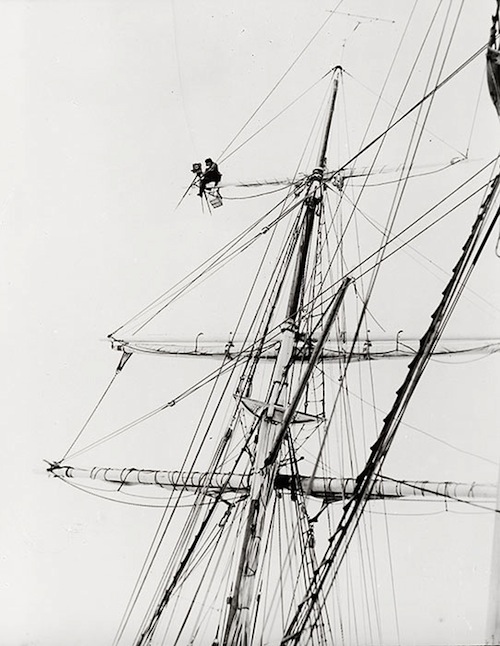
“Saw the New Year in at the wheel, under snowy conditions. A few enthusiasts joined in an Auld Lang Syne, but the majority were all sound in slumber. During the day had a very gratifying run, passing through vast fields of young ice, or rather recently formed ice in a rapid state of dissipation. The ship cut her way through in noble style, leaving a long wake which could be traced and remained open for a mile or so. I had a platform suspended from the job boom and secured some fine film. As well as pictures from the foretop yard…”

— Frank Hurley

Posted in Other Voices, Shackleton | Comments Off on New Years 1915

A glow of crimson and gold

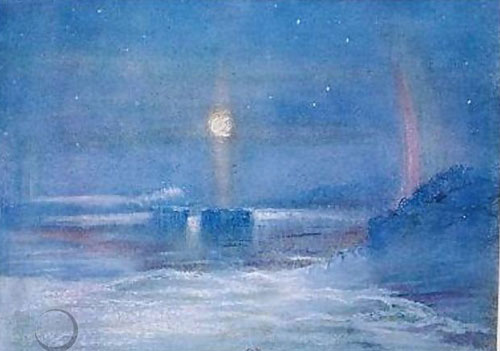
[George Marston, illustration of the Antarctic midnight sun from the Nimrod Expedition, 1907-09]

An examination of the horizon disclosed considerable breaks in the vast circle of pack-ice, interspersed with bergs of different sizes. Leads could be traced in various directions, but I looked in vain for an indication of open water. The sun did not set that night, and as it was concealed behind a bank of clouds we had a glow of crimson and gold to the southward, with delicate pale green reflections in the water of the lanes to the southeast.

— Ernest Shackleton, 30 December 1914, South

Posted in Images, Shackleton | Comments Off on A glow of crimson and gold

The sinking of the Antarctic

nordenskjold_antarctic_goingunder500

January 10, 1903:

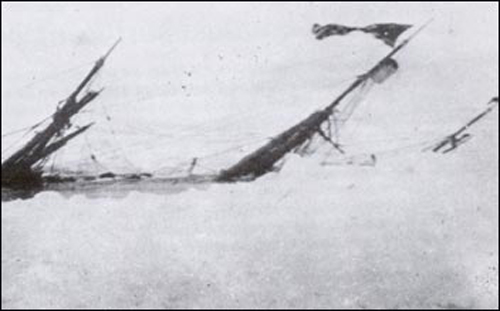
“In his diary on January 10, 1903, scientist Carl Skottsberg wrote, “During the afternoon the pressure on the sides of the vessel — which had begun yesterday — could scarcely be marked, but after dinner, just as we sat down to a hand at cards, the ship began to tremble like an aspen leaf, and a violent crash sent us all up on deck to see what the matter was. The pressure was tremendous; the vessel rose higher and higher, while the ice was crushed to powder along her sides”.”

“We stand in a long row on the edge of the ice”, wrote Skottsberg, “and cannot take our eyes off her…The pumps are still going, but the sound grows fainter and fainter…she is breathing her last. She sinks slowly deeper and deeper…Now the name disappears from sight. Now the water is up to the rail, and with a rattle, the sea and bits of ice rush in over her deck. That sound I can never forget, however long I may live. Now the blue and yellow colours are drawn down into the deep. The mizzen-mast strikes against the edge of our floe and is snapped off; the main-mast strikes and breaks; the crow’s nest rattles against the ice-edge, and the streamer, with the name ANTARCTIC disappears in the waves. The bowsprit — the last mast-top — She is gone!””

October 12, 1903:

“[Gunnar] Andersson wrote, “At 1 PM we had halted at the cape in order to prepare dinner. Groups of seals lay here and there upon the ice; we had just passed by a couple of the animals, and a large family lay some distance further out. ‘What the deuce can those seals be, standing up there bolt upright?’ says one of us, pointing to some small, dark objects far away on the ice, in towards the channel. ‘They are moving’, cries another. A delirious eagerness seizes us. A field-glass is pulled out. ‘It’s men! It’s men!’ we shout”.”

— excerpts at south-pole.com; from Antarctica: Or, Two years amongst the ice of the South Pole, by Otto Nordenskjöld

Posted in Images, Other Voices | 1 Comment

Nordenskjöld’s diary

The Antarctic

The Antarctic

“We were now sailing a sea across which none had hitherto voyaged. The weather had changed as if by magic; it seemed as though the Antarctic world repented of the inhospitable way in which it had received us the previous day, or, maybe, it merely wished to entice us deeper into its interior in order the more surely to annihilate us. At all events, we pressed onward, seized by that almost feverish eagerness which can only be felt by an explorer who stands upon the threshold of the great unknown”.

— Otto Nordenskjöld, 1902 [diary excerpts at south-pole.com]

Posted in Other Voices | Comments Off on Nordenskjöld’s diary