Full Polar Equipment

“All hands were issued with full polar equipment, as follows: 1 sweater (thick Jaeger), 1 pair Amundsen pattern Burberry boots, 1 pair Shetland wool mitts, 1 woollen helmet, 2 pair soft wool bed socks, 1 pair mittens, 1 pair finnesko (reindeer skin) boots, 1 Shetland wool jersey, 2 Jaeger shirts, 2 Jaeger combinations, 1 pair felt mitts, 1 pair fur mitts, 1 pair lambskin mitts, 1 pair Jaeger slippers, 3 pair thick woollen socks, 2 pair Shetland wool socks.”

— Thomas Orde-Lees

Posted in Other Voices | Comments Off on Full Polar Equipment

Dogloos

Dogloo village, 1915

“All hands engaged in building igloos, or as the sailors term them, dogloos, from ice blocks and snow.”

— Frank Hurley

“Worsley took a party to the floe on the 26th and started building a line of igloos and “dogloos” round the ship. These little buildings were constructed, Esquimaux fashion, of big blocks of ice, with thin sheets for the roofs. Boards or frozen sealskins were placed over all, snow was piled on top and pressed into the joints, and then water was thrown over the structures to make everything firm. The ice was packed down flat inside and covered with snow for the dogs, which preferred, however, to sleep outside except when the weather was extraordinarily severe. The tethering of the dogs was a simple matter. The end of a chain was buried about eight inches in the snow, some fragments of ice were pressed around it, and a little water poured over all. The icy breath of the Antarctic cemented it in a few moments.”

— Ernest Shackleton, South

“Putting the dogs ashore meant each dog could be given a longer lead than was possible on deck and therefore more freedom. Fastening the chains is a simple matter. A hole is made in the ice with a crowbar 6in deep, filled up with water, which instantly freezes and secures the chain tightly enough to hold back a steamroller.”

— Thomas Orde-Lees

Posted in Images, Other Voices, Shackleton | Comments Off on Dogloos

Macklin and friends

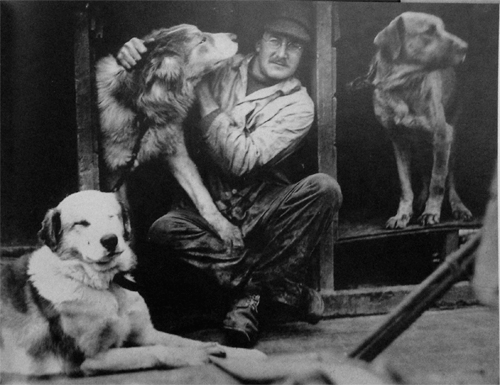
dogs_macklin

Dr. Alexander Macklin and a few friends, 1915.

Posted in Images | Comments Off on Macklin and friends

The barking will be less audible

dogs_deck

“Most of the dog kennels have been put out on the floe and the dogs in future will live there. This will be a great relief to us, for there will be no more cleaning up to do on board, no more rattling of chains at night, and the barking will be less audible.”

— Thomas Orde-Lees

Posted in Images, Other Voices | Comments Off on The barking will be less audible

Much to their delight

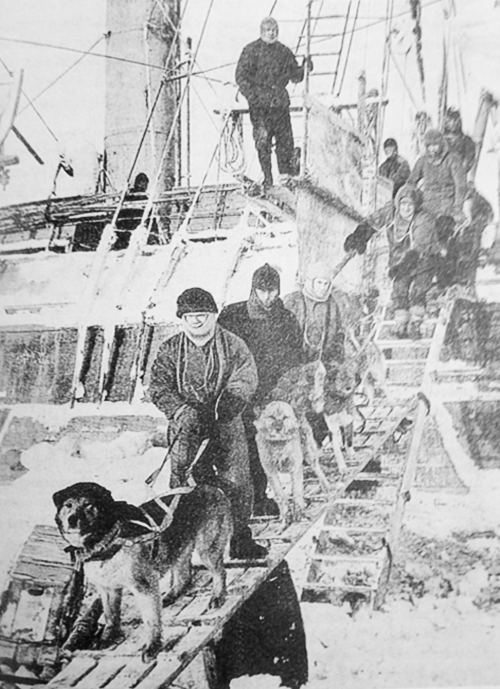
dogs_gangplank

“Dogs all placed on shore, much to their delight.”

— Frank Hurley

Posted in Images, Other Voices | Comments Off on Much to their delight

Momentous questions

jigsaw1

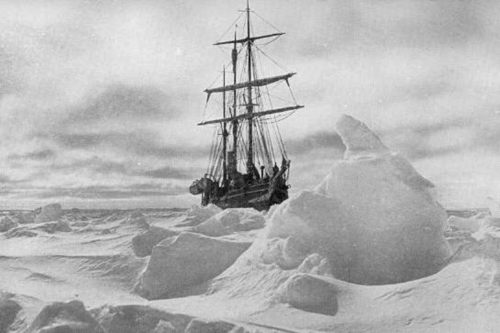
“We must wait for the spring, which may bring us better fortune. If I had guessed a month ago that the ice would grip us here, I would have established our base at one of the landing-places at the great glacier. But there seemed no reason to anticipate then that the fates would prove unkind. This calm weather with intense cold in a summer month is surely exceptional. My chief anxiety is the drift. Where will the vagrant winds and currents carry the ship during the long winter months that are ahead of us? We will go west, no doubt, but how far? And will it be possible to break out of the pack early in the spring and reach Vahsel Bay or some other suitable landing-place? These are momentous questions for us.”

— Ernest Shackleton, South

Posted in Images, Shackleton | Comments Off on Momentous questions

Ship drawings

“We now practically cease being a ship and become a shore station.” — Frank Hurley

ship1_drawing

Drawings by Frank Hurley, reproduced from Hurley’s diaries in Shackleton’s Photographer (CD), Shane Murphy, 2001.

ship2_drawing
Posted in Images, Other Voices | Comments Off on Ship drawings

Young Ice

nilas_ice

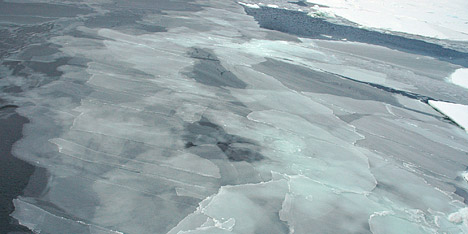
“During the morning, went for a stroll to the old lead ahead, which which is now nearly a foot thick. I was much interested in examining the contexture of the recent young ice formed on the lead and on some pools in our vicinity. The growth commences by the formation of small fish scale-like crystals which accumulate, without definite orientation, in horizontal layers. This formation extends below the surface for about half an inch, when the small plate crystals gradually arrange themselves till they become vertical. This is probably due to the heavier saline solution sinking and so directing automatically the disposition of the plates. The accretion continues by the increments of these vertical scales. This new ice fractures at right angles to its plane. The ice subsequently undergoes further recrystallization, appearing distinctly fibrous in texture.”

— Frank Hurley

[Image of nilas ice from earthlyissues.com]

Posted in Images, Other Voices | Comments Off on Young Ice

I had to admit that further effort was useless

chopping_leads

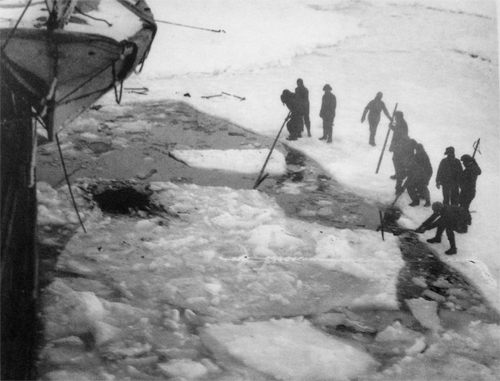
“Early in the morning of the 14th I ordered a good head of steam on the engines and sent all hands on to the floe with ice-chisels, prickers, saws, and picks. We worked all day and throughout most of the next day in a strenuous effort to get the ship into the lead ahead. The men cut away the young ice before the bows and pulled it aside with great energy. After twenty-four hours’ labour we had got the ship a third of the way to the lead. But about 400 yards of heavy ice, including old rafted pack, still separated the Endurance from the water, and reluctantly I had to admit that further effort was useless. Every opening we made froze up again quickly owing to the unseasonably low temperature. The young ice was elastic and prevented the ship delivering a strong, splitting blow to the floe, while at the same time it held the older ice against any movement.”

— Ernest Shackleton, South

Posted in Images, Shackleton | Comments Off on I had to admit that further effort was useless

Air of Unreality

“Everything wears an air of unreality… Everything on the horizon appears drawn up & distorted…icebergs hang upside down in the sky… The tops of some of the bergs appear to boil up & rise & fall & spread themselves… in the quaintest way. Inshore appears a beautiful dazzling city of Cathedral spires, domes & minarets.”

— Frank Worsley

“Cloud-banks look like land, icebergs masquerade as islands or nunataks, and the distant barrier to the south is thrown into view, although it really is outside our range of vision. Worst of all is the deceptive appearance of open water, caused by the refraction of distant water, or by the sun shining at an angle on a field of smooth snow or the face of ice-cliffs below the horizon.”

— Ernest Shackleton, South

Posted in Other Voices | Comments Off on Air of Unreality