
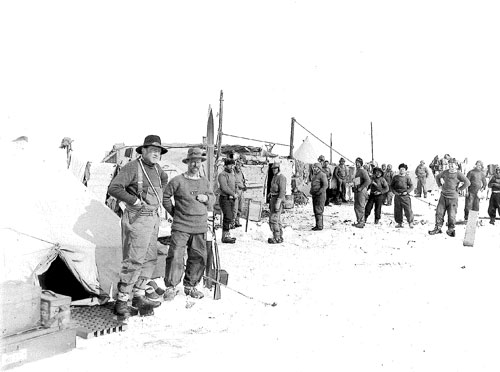
“We have called our camp Patience Camp.”
— Thomas Orde-Lees
“We have called our camp Patience Camp.”
— Thomas Orde-Lees
Alfred Lansing:
“Never had the going been worse, especially for the men pulling the boats. After two hours of struggling they had covered less than a thousand yards. McNeish suddenly turned on Worsley and refused to go on. Worsley gave him a direct order to resume his position guiding the rear of the sledge.
“McNeish refused.
“He argued that legally he was under no obligation to follow orders since the ship had gone down, and therefore the articles he had signed to serve on board her had been terminated, and he was free to obey or not, as he chose. For the past two days [McNeish] had been complaining openly. Now he simply refused to continue.
“It was a situation far beyond Worsley’s limited abilities as a leader. Had he been a less exciteable individual, he might have been able to cope with McNeish. … Worsley impulsively notified Shackleton. This served only to aggravate McNeish’s resentment.
“Shackleton hurried back from the head of the column and took McNeish aside and told him ‘very strongly’ what his duty was. … ”
“Even after Shackleton’s talk, [McNeish] remained obstinate. After a time, Shackleton walked away to let the carpenter come to his senses by himself. At 6am, when they set out again to find a good campsite, McNeish was in his assigned position at the stern of the boat sledge.”
— Alfred Lansing, Endurance
Roland Huntford:
“Shackleton stopped. At Buenos Aires, he announced, he had signed on as Master. Worsley became Sailing Master. That was not exactly true. It was, however, what Shackleton had hurriedly improvised with Worsley. It was what he now authoritatively explained, with every sign of conviction in his voice. He remained, therefore, not only leader of the expedition, but lawful Master too. Thus, he implied, he exercised both moral and legal authority.
“In any case, he declared Ship’s Articles had not been terminated by the loss of the Endurance. A special clause ensured that. This, too, was specious. Shackleton wound up by explaining that neither had wages ceased, as under ordinary articles. They would continue until return to port. That also was contrived on the spur of the moment, and was good enough for the crew.”
— Roland Huntford, Shackleton

“Most of the men wore heavy Burberry-Durox boots—ankle high leather boots with gabardine uppers reaching to the knee—designed for marching on hard ice. But as the party struggled over the slushy floes, those boots continually filled with water. In the soaked state, each weighed about 7 pounds. It was an exhausting exertion at every step to lift one foot and then the other out of 2-foot holes of snowy slush.”
— Alfred Lansing, Endurance
My Star
All, that I know
Of a certain star
Is, it can throw
(Like the angled spar)
Now a dart of red,
Now a dart of blue
Till my friends have said
They would fain see, too,
My star that dartles the red and the blue!
Then it stops like a bird; like a flower, hangs furled:
They must solace themselves with the Saturn above it.
What matter to me if their star is a world?
Mine has opened its soul to me; therefore I love it.
by Robert Browning
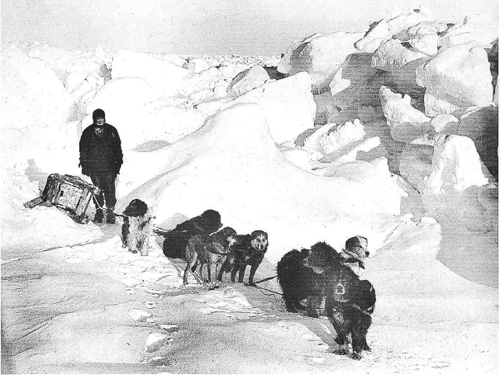
“Today, driving the dog team and hauling the boats for dear life across the Weddell Sea pack ice… We had a strenuous time getting through hummocks and filling in small leads. We covered 2 1/2 miles, but the surface was atrocious. The dogs did excellent work. Continuous wet feet for all. Temperature, plus 34°. We spied out a track this evening for two miles ahead for the morrow’s march. Wind favourable, and hauling the boats was assisted by hoisting our sails. Seal secured.”
— Frank Hurley
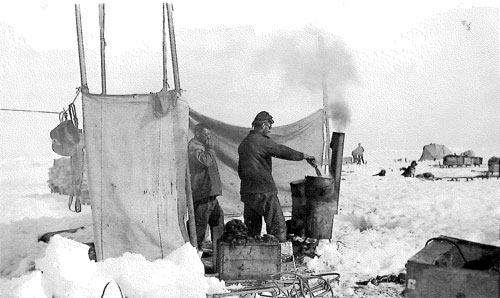
“No washing of self or dishes, no undressing, no changing clothes. Food any how and always strongly impregnated with blubber smoke, sleeping almost on bare snow and working as hard as the human physique is capable of doing on a minimum of food.”
— Thomas Orde-Lees

Pickle jar from Shackleton’s Nimrod Expedition, 1907-09
“The Endurance has been crushed and abandoned at 69° 5′ South, 51° 35′ West, and the members of the Imperial Trans-Antarctic Expedition are now at 67° 9′ South, 52° 25′ West, and proceeding to the west across the ice in the hopes of reaching land. The message concluded: ‘All well.’ Dated December 23, 1915, and signed, ‘Ernest Shackleton.'”
— Alfred Lansing, Endurance: Shackleton’s Incredible Voyage
[Image of pickle jar from the Nimrod Expedition. Auctioned in 2010: Lot # 275: SHACKLETON’S HUT ANTARCTICA ARTIFACT PICKLE JAR, “appears to have been washed.” Item listed as sold.]

“Today the members of one tent expressed their indifference as to whether they had their share (one bottle) of Heinz’s mustard dressing, of which I am particularly fond. I asked what they would have in exchange and they replied ‘four bannocks’. I closed with them on behalf of my own tent, thinking that I would easily be able to get four out of our eight members to contribute one bannock each towards the purchase of so unique and piquant a dainty, but when it came to the point I found none of my tent-mates willing to forego the solid satisfaction of the bannock in favour of the somewhat ethereal condiment.”
“In the end, rather than go back on my bargain, I am now under an obligation to raise the whole four bannocks myself, which I can do only by forfeiting my whole day’s supply tomorrow. I am not to be pitied however, for I am quite well satisfied with my bargain. I will have a whole 8oz bottle to myself: I shan’t offer anyone a drop, for they all had their opportunity to share it with me.”
— Thomas Orde-Lees
[image: morfauction.com]

“Monotony in the meals, even considering the circumstances in which we found ourselves, was what I was striving to avoid, so our little stock of luxuries, such as fish paste, tinned herrings, etc., was carefully husbanded and so distributed as to last as long as possible.
“A few boxes of army biscuits soaked with sea water were distributed at one meal. They were in such a state that they would not have been looked at a second time under ordinary circumstances, but to us on a floating lump of ice, over three hundred miles from land, and that quite hypothetical, and with the unplumbed sea beneath us, they were luxuries indeed. Wild’s tent made a pudding of theirs with some dripping.”
— Ernest Shackleton, South
[image from inventingeurope.eu]
“A human being’s normal diet should contain the three main constituents of food, protein, fat and carbo-hydrates in the proportion of 1-1-2 1/2 respectively whatever the actual weights. I.e. the carbohydrates (farinaceous foods and sugar) should be more than double the other two … As it is, our flour will only last out another 10 weeks at the most.”
— Thomas Orde-Lees
 Shackleton.