

Leonard Hussey, Meteorologist
— Ernest Shackleton, South
Leonard Hussey, Meteorologist
— Ernest Shackleton, South
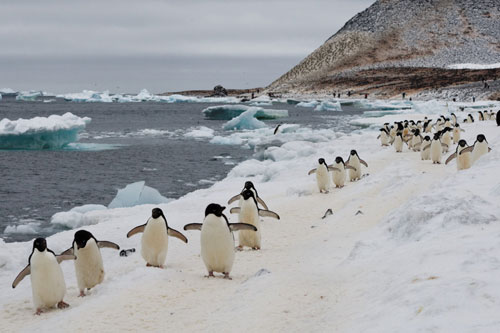
Adelies on Paulet Island by Allan Hansen, 2009
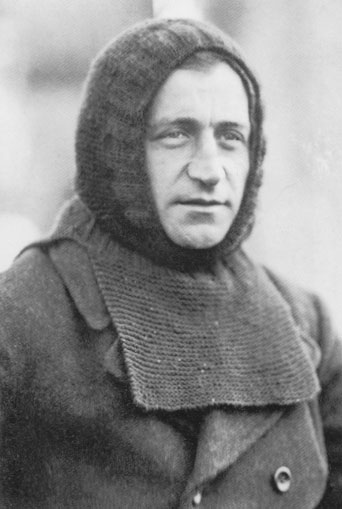
Robert Clark, Biologist
— Ernest Shackleton, South
I had been prepared for evil conditions in the Weddell Sea, but had hoped that in December and January, at any rate, the pack would be loose, even if no open water was to be found. What we were actually encountering was a fairly dense pack of a very obstinate character. Pack ice might be described as a gigantic and interminable jigsaw puzzle devised by Nature. The parts of the puzzle in loose pack have floated slightly apart and become disarranged; at numerous places they have pressed together again; as the pack gets close the congested areas grow larger and the parts are jammed harder til finally it becomes “close pack,” when the whole of the jigsaw puzzle becomes jammed to such an extent that with care and labor it can be traversed in every direction on foot. Where the parts do not fit closely there is, of course, open water, which freezes over in a few hours after giving off volumes of “frost-smoke.” In obedience to renewed pressure this young ice “rafts,” so forming double thicknesses of a toffeelike consistency. Again the opposing edges of heavy floes rear up in slow and almost silent conflict, till high “hedgerows” are formed round each part of the puzzle. At the junction of several floes chaotic areas of piled-up blocks and masses of ice are formed. Sometimes 5-ft to 6-ft piles of evenly shaped blocks of ice are seen so neatly laid that it seems impossible for them to be Nature’s work. Again, a winding canyon may be traversed between icy walls 6 f to 10 ft high, or a dome may be formed that under renewed pressure bursts upward like a volcano. All through the winter the drifting pack changes — grows by freezing, thickens by rafting, and corrugates by pressure. If, finally, in its drift it impinges upon a coast, such as the western short of the Weddell Sea, terrific pressure is set up and an inferno of ice blocks, ridges, and hedgerows results, extending possibly for 150 or 200 miles off shore. Sections of pressure ice may drift away subsequently and become embedded in new ice.
Another point that may require to be explained was the delay caused by wind while we were in the pack. When a strong breeze or moderate gale was blowing the ship could not safely work through any except young ice, up to about 2 feet in thickness. As ice of that nature never extended more than a mile or so, it followed that in a gale in the pack we always had to lie to.
— Ernest Shackleton, South
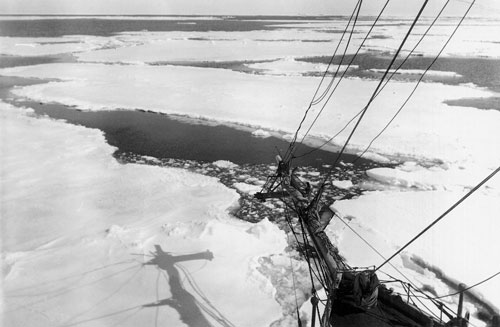
When the way was barred by a floe of moderate thickness we would drive the ship at half speed against it, stopping the engines just before the impact. At the first blow the Endurance would cut a V-shaped nick in the face of the floe, the slope of her cutwater often causing her bows to rise till nearly clear of the water, when she would slide backwards, rolling slightly. Watching carefully that loose lumps of ice did not damage the propeller, we would reverse the engines and back the ship off 200 to 300 yards. She would then be driven full speed into the V, taking care to hit the center accurately. The operation would be repeated until a short dock was cut, into which the ship, acting as a large wedge, was driven. At about the fourth attempt, if it was to succeed at all, the floe would yield. A black, sinuous line, as though pen-drawn on white paper, would appear ahead, boradening as the eye traced it back to the ship. Presently it would be broad enough to receive her, and we would forge ahead. Under the bows and alongside, great slabs of ice were being turned over and slid back on the floe, or driven down and under the ice and ship. In this way the Endurance would split a 2-ft. to 3-ft. floe a square mile in extent. Occasionally the floe, although cracked across, would be so held by other floes that it would refuse to open wide, and so gradually would bring the ship to a standstill. We would then go astern for some distance and again drive her full speed into the crack, till finally the floe would yield to the repeated onslaughts.
— Ernest Shackleton, South

Frank Hurley, expedition photographer
— Worsley

Hurley in the rigging, Shackleton on deck.
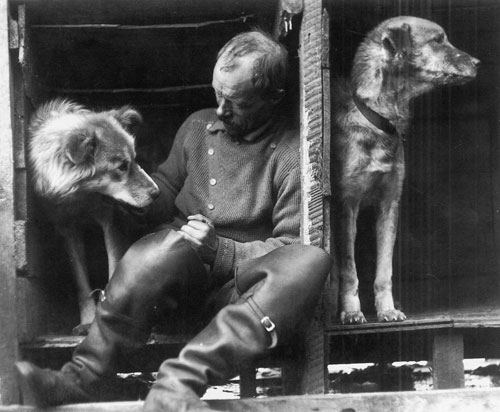
Frank Wild, Second-in-command, Endurance
— Alexander Macklin, Surgeon
“Each watch had its characteristics. Worsley specialised in ramming, and I have a sneaking suspicion that he often went out of his way to find a nice piece of floe at which he could drive at full speed and cut in two; he loved to feel the shock, the riding up, and the sensation, as the ice gave and we drove through.”
— Alexander Macklin, Surgeon
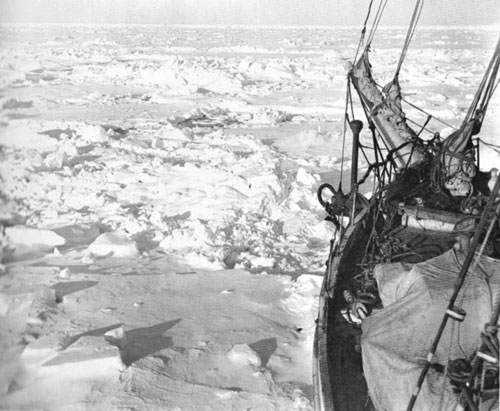
But the Weddell Sea was notoriously inhospitable, and already we knew that its sternest face was turned towards us. All the conditions in the Weddell Sea are unfavorable from the navigator’s point of view. The winds are comparatively light, and consequently new ice can form even in the summertime. The absence of strong winds has the additional effect of allowing the ice to accumulate in masses, undisturbed. Then great quantities of ice sweep along the coast from the east under the influence of the prevailing current, and fill up the bight of the Weddell Sea as they move north in a great semicircle. Some of this ice doubtless describes almost a complete circle, and is held up eventually, in bad seasons, against the South Sandwich Islands. The strong currents, pressing the ice masses against the coasts, create heavier pressure than is found in any other part of the Antarctic. The pressure must be at least as severe as the pressure experienced in the congested North Polar basin, and I am inclined to think that a comparison would be to the advantage of the Arctic. All these considerations naturally had a bearing upon our immediate problem, the penetration of the pack and the finding of a safe harbor on the continental coast.
— Ernest Shackleton, South

The Antarctic
“…seems to me more glorious than if she had gone to meet the usual fate of vessels to slowly rot in some port, or to be used for something far off from her designation and purposes as an icy seas and research vessel.”
— Alfred Gabriel Nathorst, the Antarctic’s previous owner
 Shackleton.