Ratcliffe Highway (2)

Ratcliffe Highway performed by The Dubliners

Posted in Video | Comments Off on Ratcliffe Highway (2)

Ratcliffe Highway (1)

RatcliffeHighwayMurders-Map1811-lores9-600x430

“One would imagine he is in Ratcliffe Highway or some other den by the language that is being used. I have been shipmates with all sorts of men both in sail and steam, but never nothing like some of our party – as the most filthy language is used as terms of endearment, and, worse of all, is tolerated.”

— Harry McNeish

Posted in Images, Other Voices | Comments Off on Ratcliffe Highway (1)

Scrappy bits

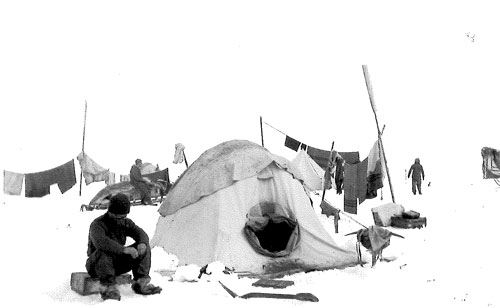
camp-oneigloo

“Tent walls are very thin, thinner than this paper, and they have ears on both sides — inside & outside and many are the scrappy bits one hears which one ‘didn’t ought’ to hear.”

— Thomas Orde-Lees

Posted in Images, Other Voices | Comments Off on Scrappy bits

Monotony foiled

“Monotony in the meals, even considering the circumstances in which we found ourselves, was what I was striving to avoid, so our little stock of luxuries, such as fish paste, tinned herrings, etc., was carefully husbanded and so distributed as to last as long as possible.

“A few boxes of army biscuits soaked with sea water were distributed at one meal. They were in such a state that they would not have been looked at a second time under ordinary circumstances, but to us on a floating lump of ice, over three hundred miles from land, and that quite hypothetical, and with the unplumbed sea beneath us, they were luxuries indeed. Wild’s tent made a pudding of theirs with some dripping.”

— Ernest Shackleton, South

Posted in Shackleton | Comments Off on Monotony foiled

A human being’s normal diet

“A human being’s normal diet should contain the three main constituents of food, protein, fat and carbo-hydrates in the proportion of 1-1-2 1/2 respectively whatever the actual weights. I.e. the carbohydrates (farinaceous foods and sugar) should be more than double the other two … As it is, our flour will only last out another 10 weeks at the most.”

— Thomas Orde-Lees

Posted in Other Voices | Comments Off on A human being’s normal diet

Bitter sobs and lamentations

“Sounds of bitter sobs and lamentations are heard this evening from No. 5 tent at the loss of their dearly beloved ‘Colonel’ [Orde-Lees] who has removed himself for a season to sleep in his store in the old wheelhouse. He indulgently yields to our earnest entreaties to continue to dine with us and comforts us with the assurance that he will return promptly to our Humble but Happy Home immediately we prepare to get on the march.”

— Frank Worsley

Posted in Other Voices | Comments Off on Bitter sobs and lamentations

My birthday

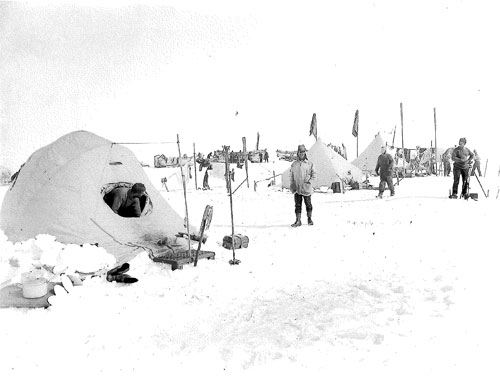
camp-bday

“Polar explorer ERNEST SHACKLETON (1874-1922) is today’s go-to fearless leader, although he didn’t discover the South Pole or cross the Antarctic continent. What he did do made such feats pale in comparison. In 1914, his ship, The Endurance, was crushed by pack ice, stranding his Imperial Trans-Antarctic Expedition beyond hope of radio or rescue. Shackleton led twenty-seven men on a nearly two-year journey across shifting ice floes, treacherous oceans, and uninhabited island edges. Their adventure culminated in a near-suicidal 800-mile lifeboat journey across the roughest seas in the world, as well as an impromptu, inexperienced traverse of an uncharted and glacier-ridden mountain range. The story of The Endurance involves so much suspension of disbelief (even though it’s all true) that every film about it has fallen short, and every written account has been crushed by the packed action. In 1917, when he returned everyone under his care alive, a nation shrugged and got back to the business of slaughter. But Shackleton’s irrepressible optimism and perseverance outlasted his era, and today his adventure is recognized for what it was: the most excellent.”

Ernest Shackleton by Peggy Nelson, 2011; part of the ongoing HiLo Heroes series on HiLobrow.com.

Posted in Images, Shackleton | Comments Off on My birthday

Day by day

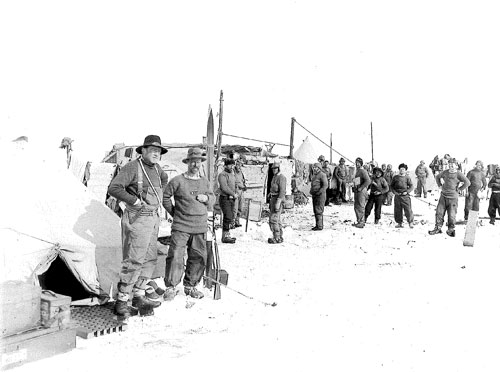
camp-twoigloos
Posted in Images | Comments Off on Day by day

Laundry

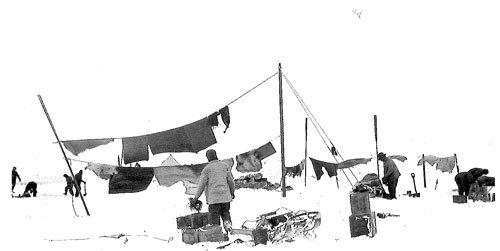
camp-dryingthings
Posted in Images | Comments Off on Laundry

All this becomes your Mode of Life

eothen

“The first night of your first campaign (though you be but a mere peaceful campaigner) is a glorious time in your life. It is so sweet to find one’s self free from the stale civilisation of Europe! Oh my dear ally, when first you spread your carpet in the midst of these Eastern scenes, do think for a moment of those your fellow-creatures, that dwell in squares, and streets, and even (for such is the fate of many!) in actual country houses; think of the people that are “presenting their compliments,” and “requesting the honour,” and “much regretting,”—of those that are pinioned at dinner-tables; or stuck up in ballrooms, or cruelly planted in pews—ay, think of these, and so remembering how many poor devils are living in a state of utter respectability, you will glory the more in your own delightful escape.

“I am bound to confess, however, that with all its charms a mud floor (like a mercenary match) does certainly promote early rising. Long before daybreak we were up, and had breakfasted; after this there was nearly a whole tedious hour to endure whilst the horses were laden by torch-light; but this had an end, and at last we went on once more. Cloaked, and sombre, at first we made our sullen way through the darkness, with scarcely one barter of words, but soon the genial morn burst down from heaven, and stirred the blood so gladly through our veins, that the very Suridgees, with all their troubles, could now look up for an instant, and almost seem to believe in the temporary goodness of God.

“The actual movement from one place to another, in Europeanised countries, is a process so temporary—it occupies, I mean, so small a proportion of the traveller’s entire time—that his mind remains unsettled, so long as the wheels are going; he may be alive enough to external objects of interest, and to the crowding ideas which are often invited by the excitement of a changing scene, but he is still conscious of being in a provisional state, and his mind is constantly recurring to the expected end of his journey; his ordinary ways of thought have been interrupted, and before any new mental habits can be formed he is quietly fixed in his hotel. It will be otherwise with you when you journey in the East. Day after day, perhaps week after week and month after month, your foot is in the stirrup. To taste the cold breath of the earliest morn, and to lead, or follow, your bright cavalcade till sunset through forests and mountain passes, through valleys and desolate plains, all this becomes your MODE OF LIFE, and you ride, eat, drink, and curse the mosquitoes as systematically as your friends in England eat, drink, and sleep. If you are wise, you will not look upon the long period of time thus occupied in actual movement as the mere gulf dividing you from the end of your journey, but rather as one of those rare and plastic seasons of your life from which, perhaps, in after times you may love to date the moulding of your character—that is, your very identity. Once feel this, and you will soon grow happy and contented in your saddle-home. As for me and my comrade, however, in this part of our journey we often forgot Stamboul, forgot all the Ottoman Empire, and only remembered old times. We went back, loitering on the banks of Thames—not grim old Thames of ‘after life,’ that washes the Parliament Houses, and drowns despairing girls—but Thames, the ‘old Eton fellow,’ that wrestled with us in our boyhood till he taught us to be stronger than he. We bullied Keate, and scoffed at Larrey Miller, and Okes; we rode along loudly laughing, and talked to the grave Servian forest as though it were the ‘Brocas clump.'”

— excerpt from Eothen, or, Traces of Travel Brought Home from the East, by A. W. Kinglake: online text.

Posted in Other Voices | Comments Off on All this becomes your Mode of Life