The boats

“I had decided to take the James Caird myself, with Wild and eleven men. This was the largest of our boats, and in addition to her human complement she carried the major portion of the stores. Worsley had charge of the Dudley Docker with nine men, and Hudson and Crean were the senior men on the Stancomb Wills.”

— Ernest Shackleton, South

In the James Caird: Shackleton, Wild, Clark, Hurley, Hussey, James, Wordie, McNeish, Green, Vincent, McCarthy.

In the Dudley Docker: Worsley, Greenstreet, Kerr, Lees, Macklin, Cheetham, Marston, McLeod, Holness.

In the Stancomb Wills: Crean and Hudson, and Rickinson, McIlroy, How, Bakewell, Blackboro, Stephenson.

The Dudley Docker and Stancomb Wills are cutters, “heavy, square-sterned boats of solid oak,” also known as dreperbåts, originally built for hunting bottlenose whales. Approx. 21 ft long each.

The James Caird is a double-ended whaleboat, larger, than the other two, but lighter and springier. Baltic pine planking over a framework of American elm and English oak, custom-made to Worsley’s specifications. Approx. 22 ft 6 in long.
Posted in Shackleton | Comments Off on The boats

How fragile and precarious

“I stood on the edge of the new fracture, and, looking across the widening channel of water, could see the spot where for many months my head and shoulders had rested when I was in my sleeping bag. The depression formed by my body and legs was on our side of the crack. The ice had sunk under my weight during the months of waiting in the tent, and I had many times put snow under the bag to fill the hollow.”

“How fragile and precarious had been our resting place! Yet usage had dulled our sense of danger. The floe had become our home, and during the early months of the drift we had almost ceased to realize that it was but a sheet of ice floating on unfathomed seas. Now our home was being shattered under our feet, and we had a sense of loss and incompleteness hard to describe.”

— Ernest Shackleton, South

Posted in Shackleton | Comments Off on How fragile and precarious

Our case would be desperate

“The movement of the ice in the swell was increasing, and the floe might split right under our camp. Our case would be desperate if the ice broke into small pieces not large enough to support our party and not loose enough to permit the use of the boats.”

— Ernest Shackleton, South

Posted in Shackleton | Comments Off on Our case would be desperate

A particularly heavy shock

“The trouble was not caused by a blow from another floe. We could see that the piece of ice we occupied had slewed and now presented its long axis towards the oncoming swell. The floe, therefore, was pitching in the manner of a ship, and it had cracked across when the swell lifted the center.”

— Ernest Shackleton, South

Posted in Shackleton | Comments Off on A particularly heavy shock

No bergs

“There has been some discussion in the camp as to the advisability of making one of the bergs our home for the time being and drifting with it to the west. The idea is not sound. I cannot be sure that the berg would drift in the right direction. If it did move west and carried us into the open water, what would be our fate when we tried to launch the boats down the steep sides of the berg in the sea swell after the surrounding floes had left us? One must reckon, too, the chance of the berg splitting or even overturning during our stay… No, I do not like the idea of drifting on a berg.”

— Ernest Shackleton, South

Posted in Shackleton | Comments Off on No bergs

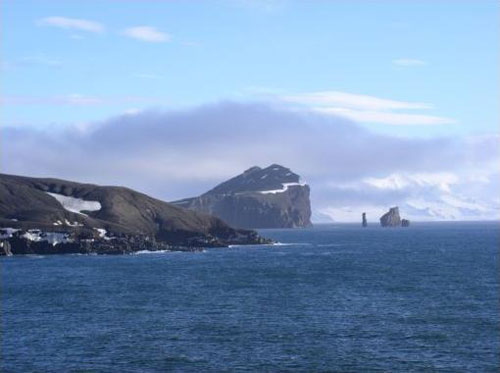
Deception Island

Deception Island

Deception Island

“We knew from the Admiralty Sailing Directions that there were stores for the use of shipwrecked mariners on Deception Island, and it was possible that the summer whalers had not yet deserted its harbor.

“Also we had learned from our scanty records that a small church had been erected there for the benefit of the transient whalers. The existence of this building would mean to us a supply of timber, from which, if dire necessity urged us, we could construct a reasonably seaworthy boat.

“All of [our boats] were small for the navigation of these notoriously stormy seas, and they would be heavily loaded, so a voyage in open water would be a serious undertaking.

“In any case, the worst that could befall us would be a wait until the whalers returned about the middle of November.

“The Admiralty Sailing Directions, referring to the South Shetlands, mentioned a cave on this island. None of us had seen that cave or could say if it was large or small, wet or dry; but as we drifted on our floe… that cave seemed to my fancy to be a palace which in contrast would dim the splendors of Versailles.”

— Ernest Shackleton, South

Posted in Shackleton | Comments Off on Deception Island

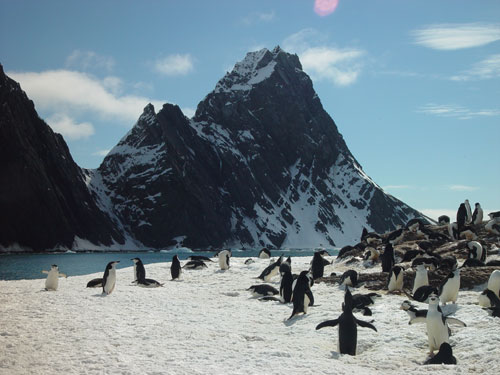
Elephant Island

Elephant Island

Elephant Island

“It seems vital that we shall land on Clarence Island or its neighbor, Elephant Island. The latter island has an attraction for us, although as far as I know nobody has ever landed there. Its name suggests the presence of the plump and succulent sea elephant.”

— Ernest Shackleton, South

Posted in Shackleton | Comments Off on Elephant Island

Hopes and worries

Clarence Island

Clarence Island

“Our drifting home had no rudder to guide it, no sail to give it speed.”

“We were dependent upon the caprice of wind and current; we went whither those irresponsible forces listed.”

“The floe has been a good friend to us, & it is reaching the end of its journey.”

“It is liable at any time now to break up and fling us into the unplumbed sea.”

“The longing to feel solid earth under our feet filled our hearts.”

“One strong gale followed by a calm would scatter the pack, I think, and then we could push through.”

— various voices, the crew of the Endurance

Posted in Other Voices | Comments Off on Hopes and worries

Sea Creatures

“We hear and see whales blowing all around absolutely continuously at times. A particularly ugly killer poked his head up and had a look around by our floe. Penguins are croaking… and occasionally a shoal of them swim through a pool with a peculiar leaping movement like great fleas hopping along the water surface, and looking fine in the brilliant sunshine. About twenty seals were visible…this morning at one time. Crowds of snow petrels are on the wing, with occasional giant petrels and skua gulls.”

— Reginald James

Posted in Other Voices | Comments Off on Sea Creatures

Clarence Island

“At first it had the appearance of a huge berg, but with the growing light we could see plainly the black lines of scree and the high, precipitous cliffs of the island, which were miraged up to some extent.

“…not until Worsley, WIld, and Hurley had unanimously confirmed my observation was I satisfied that I was really looking at Clarence Island. The land was still more than sixty miles away, but it had to our eyes something of the appearance of home, since we expected to find there our first solid footing after all the long months of drifting on the unstable ice.

“In the full daylight Clarence Island ceased to look like land and had the appearance of a berg not more than eight or ten miles away, so deceptive are distances in the clear air of the Antarctic.

“The sharp white peaks of Elephant Island showed to the west of north a little later in the day.

“The island is the last outpost of the south and our final chance of a resting place. Beyond it lies the broad Atlantic. Our little boats may be compelled any day now to sail unsheltered over the open sea with a thousand leagues of ocean separating them from the land to the north and east.”

— Ernest Shackleton, South

Posted in Shackleton | Comments Off on Clarence Island