In the event of my not surviving (3)

Letter from Shackleton to McNeish, written in McNeish’s notebook:

“May 18, 1916
South Georgia

Sir

I am about to try to reach Husvik on the East Coast of this island for relief of our party. I am leaving you in charge of the party consisting of Vincent, McCarthy & yourself. You will remain here until relief arrives. You have ample seal food which you can supplement with birds and fish according to your skill. You are left with a double barrelled gun, 50 cartridges [and other rations] … You also have all the necessary equipment to support life for an indefinite period in the event of my non-return. You had better after winter is over try and sail around to the East Coast. The course I am making towards Husvik is East magnetic.

I trust to have you relieved in a few days.

Yours faithfully,

E. H. SHACKLETON

H. MCNEISH”

Posted in Shackleton | Comments Off on In the event of my not surviving (3)

Supply list

The Primus lamp filled with oil for 6 hot meals
The small hoosh pot
Two compasses
A pair of binoculars
Rope: A total length of 50 feet when knotted
McNeish’s adze, to be used as an ice axe
Worsley’s chronometer worn around his neck
Three pieces of wood from the Caird’s decking to be used as walking sticks
Matches. There were two boxes of matches left, one full and the other partially used. We left the full box with the men at the camp and took the second box, which contained forty-eight matches.
Worsley’s diary

Posted in Shackleton | Comments Off on Supply list

Ultralight

“After consultation we decided to leave the sleeping-bags behind and make the journey in very light marching order. We would take three days’ provisions for each man in the form of sledging ration and biscuit. The food was to be packed in three socks, so that each member of the party could carry his own supply.”

– Ernest Shackleton, South

Posted in Shackleton | Comments Off on Ultralight

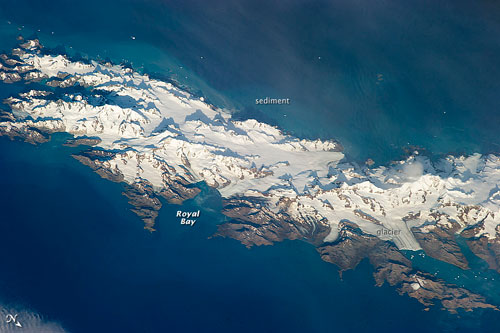
Ridges, peaks, and nunatuks

The view of South Georgia that we did not have, taken from the ISS, 2013, via @NASA_EO

The view of South Georgia that we did not have, taken from the ISS, 2013, via @NASA_EO

“Our path towards the whaling station led round the seaward end of the snouted glacier on the east side of the camp and up a snow slope that appeared to lead to a pass in the great Allardyce Range, which runs northwest and southeast and forms the main backbone of South Georgia. The range dipped opposite the bay into a well-defined pass from east to west. An ice sheet covered most of the interior, filling the valleys and disguising the configuration of the land, which, indeed, showed only in big rocky ridges, peaks, and nunatuks.

“When we looked up the pass from Peggotty Camp the country to the left appeared to offer two easy paths through to the opposite coast, but we knew that the island was uninhabited at that point (Possession Bay). We had to turn our attention further east.

“I planned to climb the pass and then be guided by the configuration of the country in the selection of a route eastward to Stromness Bay, where the whaling stations were established in the minor bays, Leith, Husvik, and Stromness. A range of mountains with precipitous slopes, forbidding peaks, and large glaciers lay immediately to the south of King Haakon Bay and seemed to form a continuation of the main range. Between this secondary range and the pass above our camp a great snow upland sloped up to the inland ice sheet and reached a rocky ridge that stretched athwart our path and seemed to bar the way. This ridge was a right-angled offshoot from the main ridge. Its chief features were four rocky peaks with spaces between that looked from a distance as though they might prove to be passes.

“[Worsley and I] went round the seaward end of the snouted glacier, and after tramping about a mile over stony ground and snow-coated debris, we crossed some big ridges of scree and moraines. We did not get much information regarding the conditions farther on owing to the view becoming obscured by a snow squall. We waited a quarter of an hour for the weather to clear but were forced to turn back without having seen more of the country.”

— Ernest Shackleton, South

Posted in Images, Shackleton | Comments Off on Ridges, peaks, and nunatuks

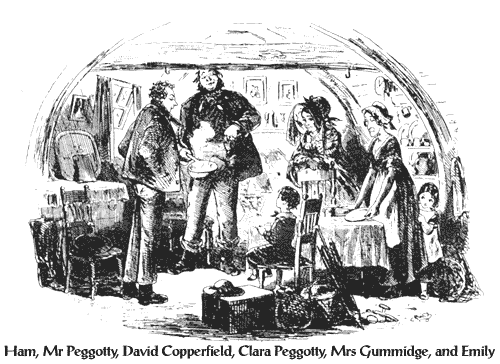
A la Peggotty

Peggotty's House made from an upturned boat

Inside Peggotty’s House made from an upturned boat

“Whether I shall turn out to be the hero of my own life, or whether that station will be held by anybody else, these pages must show.” — David Copperfield

[Illustration of Peggotty’s boat/house, from The Personal History, Adventures, Experience and Observation of David Copperfield the Younger of Blunderstone Rookery (Which He Never Meant to Publish on Any Account), by Charles Dickens.]

Posted in Images, Other Voices | Comments Off on A la Peggotty

A curious-looking party

“We were a curious-looking party, but we were feeling happy. We even broke into song, and, but for our Robinson Crusoe appearance, a casual observer might have taken us for a picnic party sailing in a Norwegian fiord or one of the beautiful sounds of the west coast of New Zealand.”

— Ernest Shackleton, South

Posted in Shackleton | Comments Off on A curious-looking party

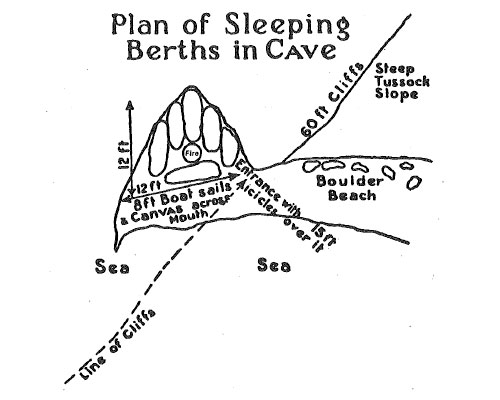
Our sleeping arrangements

cavesleepingMay14
Posted in Images | Comments Off on Our sleeping arrangements

It put me in mind of old times at Home

“I went to the top of the hill & had a lay on the grass & it put me in mind of old times at Home sitting on the hillside looking down at them.”

— Harry McNeish

Posted in Other Voices | Comments Off on It put me in mind of old times at Home

Busy at the boat

“I am still busy at the boat. While the skipper does the Nimrod & bring home the food Vincent lays down by the fire and smoks some times coming out for more wood while the Boss & Creen looks after the cooking & McCarthy is my assistant.”

— Harry McNeish

Posted in Other Voices | Comments Off on Busy at the boat

Our hunger knew no law

“We paid our last visit to the nests of the albatrosses, which were situated on a little undulating plateau above the cave amid tussocks, snow patches, and little frozen tarns. Each nest consisted of a mound over a foot high of tussock grass, roots, and a little earth. The albatross lays one egg and very rarely two. The chicks, which are hatched in January, are fed on the nest by the parent birds for almost seven months before they take to the sea and fend for themselves. Up to four months of age the chicks are beautiful white masses of downy fluff, but when we arrived on the scene their plumage was almost complete. Very often one of the parent birds was on guard near the nest. We did not enjoy attacking these birds, but our hunger knew no law. They tasted so very good and assisted our recuperation to such an extent that each time we killed one of them we felt a little less remorseful.”

— Ernest Shackleton, South

Posted in Shackleton | Comments Off on Our hunger knew no law