The fate of the crew

The Endurance:

guys

McCarthy, the best and most efficient of the sailors, always cheerful under the most trying circumstances, and who for these very reasons I chose to accompany me on the boat journey to South Georgia, was killed at his gun in the Channel.”

Cheetham, the veteran of the Antarctic, who had been more often south of the Antarctic Circle than any man, was drowned when the vessel he was serving in was torpedoed, a few weeks before the Armistice.”

“The two surgeons, Macklin and McIlroy, served in France and Italy, McIlroy being badly wounded at Ypres.”

Frank Wild, in view of his unique experience of ice and ice conditions, was at once sent to the North Russian front, where his zeal and ability won him the highest praise.”

Macklin served first with the Yorks and later transferred as medical officer to the Tanks, where he did much good work. Going to the Italian front with his battalion, he won the Military Cross for bravery in tending wounded under fire.”

James joined the Royal Engineers, Sound-Ranging Section, and after much front-line work was given charge of a Sound-Ranging School to teach other officers this latest and most scientific addition to the art of war.”

Wordie went to France with the Royal Field Artillery and was badly wounded at Armentières.”

Hussey was in France for eighteen months with the Royal Garrison Artillery, serving in every big battle from Dixmude to Saint-Quentin.”

Worsley, known to his intimates as Depth-Charge Bill, owing to his success with that particular method of destroying German submarines, has the Distinguished Service Order and three submarines to his credit.”

Clark served on a minesweeper.”

Greenstreet was employed with the barges on the Tigris.”

Rickenson was commisioned as Engineer-Lieutenant.”

R.N. Kerr returned to the Merchant Service as an engineer.”

“Most of the crew of the Endurance served on minesweepers.”

— Ernest Shackleton, South

Blackboro: On return from the Antarctic, Blackborow spent three months in a hospital in Punta Arenas, Chile, recovering from the frostbite damage sustained to his left foot. He volunteered for war service in the Royal Navy, but was turned down due to the amputation of the toes of his left foot. He was accepted by the Merchant Navy where he served until 1919.

Crean: Once again on his return to England, Crean resumed his naval career at Chatham. For the rest of the First World War, Crean served in the Royal Navy aboard HMS Colleen. In 1927 Tom opened a pub in Annascaul, “The South Pole Inn” (still in business today).

Orde-Lees: On return to England after the expedition, he served in the Balloon Service and saw action on the Western front. With Shackleton’s help, he joined the Royal Flying Corps (R.F.C.) and was a pioneering figure in parachute jumping. On one occasion, he jumped off the top of Tower Bridge into the River Thames, only about 160 or so feet below to convince the British Military of the usefulness of the parachute. Although this was just a stunt, it seemed to do the trick and the R.F.C. formed a parachute division with Orde-Lees in command.

McNeish: After the expedition McNish returned to the Merchant Navy and worked on various ships. He often complained that the extreme cold and soaking conditions he had experienced in the boat journey on the James Caird had left him so that his bones permanently ached. Other people who knew him say that he would often refuse to shake hands because of the pain.

Hurley: After the Expedition, Hurley became a noted army photographer in the First World War, then became the go-to photographer for expeditions to the tropic regions. He returned to the Antarctic in 1929.
Hurley’s photos of WWI

Marston: On return from the expedition Marston taught at Bedales school in Petersfield from 1918 to 1922. In 1925, he joined the Rural Industries Bureau (RIB) as Handicrafts Adviser, having always been a lover rural life and countryside matters, he was appointed Assistant Director in 1931 and Director in 1934.

www.coolantarctica.com

The Aurora:

Aurora_Ship

Stenhouse, who commanded the Aurora after Mackintosh landed, was with Worsley as his second in command when one of the German submarines was rammed and sunk, and received the D.S.C. for his share in the fight. He was afterwards given command of a Mystery Ship, and fought several actions with enemy submarines.”

Ernest Wild, Frank Wild’s brother, was killed while mine-sweeping in the Mediterranean.”

Mauger, the carpenter on the Aurora, was badly wounded while serving with the New Zealand infantry, so that he is unable to follow his trade again. He is now employed by the New Zealand government.”

Hooke, the wireless operator, now navigates an airship.”

“Of the Ross Sea Party, Mackintosh, Hayward, and Spencer-Smith died for their country as surely as any who gave up their lives on the fields of France and Flanders.”

“Nearly all of the crew of the Aurora joined the New Zealand Field Forces and saw active service in one or other of the many theaters of war.”

— Ernest Shackleton, South

***

Read more:
Brief biographies of the crew of the Endurance at coolantarctica.com

Posted in Images, Other Voices, Shackleton | Comments Off on The fate of the crew

The Ross Sea Party

Ross Sea party members: Back row from left: Joyce, Hayward, Cope, Spencer-Smith. Centre: Mackintosh third from left, Stenhouse fourth from left.

Ross Sea party members: Back row from left: Joyce, Hayward, Cope, Spencer-Smith. Centre: Mackintosh third from left, Stenhouse fourth from left. Photo by Frank Hurley. (Wikipedia)

A close reporting of the fate of the Ross Sea Party has been outside the scope of this narration, as I had no way of receiving news from them until some of our party had reached South Georgia, the telegraph office, and news, in 1916. The Aurora was the second ship of the Expedition, meant to sail to the Ross Sea on the other side of the continent, and to cache depots of supplies at calculated intervals between the Pole and the sea on that side. Thus (in the original plan) when the Endurance landed at Vahsel Bay and our shore party hiked to the Pole, we would only need to sledge supplies for half the voyage, and would retrieve the depots in sequence as we approached the full crossing.

As we know the full crossing did not happen, but the Aurora fulfilled her directive, and the sledging party laid depots as instructed well inland. But on their return to the shore, they found that the Aurora had been blown out to sea with most of the men, and stranded those remaining on the far side of the continent. The ship was solidly encased in a sturdy floe, which had detached from the pack and been blown far out to sea by a blizzard, and there drifted helplessly for almost 10 months. Finally it had broken free of the floe and managed to limp back to New Zealand. The shore party believed the Aurora lost at sea, and, after a second depot-laying journey, were themselves split between Hut Point and Cape Evans. Of that second foray, I wrote in my memoir South, “No more remarkable story of human endeavour has been revealed than the tale of that long march.” The survivors occupied themselves with their scientific studies, and settled in to wait for rescue from land or sea.

Mackintosh and Spencer-Smith on the sledge; "Image was "drawn and painted, probably by George Marshall, from material supplied to the artist by surviving members of the Ross Sea Party." (Wikipedia)

Mackintosh and Spencer-Smith on the sledge; “Image was ‘drawn and painted, probably by George Marshall, from material supplied to the artist by surviving members of the Ross Sea Party.'” (Wikipedia)

So after our return from Elephant Island on the Yelcho, and having arranged passage for the crew back to England and the war, I made my way with Worsley to San Francisco and from there straight to New Zealand, that I might join the Aurora before she left on the rescue mission; aboard the Aurora I reached McMurdo Sound and Cape Evans on Jan 10, 1917. There we found seven of our comrades in an even more fraught state than those on Elephant Island—although they did have a hut and supplies, they had not seen or heard anything from the outside world since December 1914. Three of the party had perished during that time: Arnold Spencer-Smith of scurvy after the second depot-laying journey, and Aeneas Mackintosh and Victor Hayward while attempting to cross from Hut Point to Cape Evans over thin ice. When we arrived we searched for another week for some trace of them, but found nothing. Spencer-Smith was interred in the ice.

Finally we headed back to New Zealand with the ten survivors—seven men and three dogs, whom the men credited with their survival. Only when this was accomplished did I make my way, via Australia, back to England and the war myself. It was 1917.

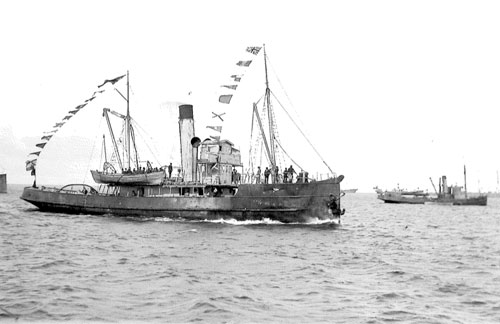
The Aurora; photographer "unknown, probably one of Aurora's crew; Shackleton never mentioned who took this photo in any of his books or records." (Wikipedia)

The Aurora; photographer “unknown, probably one of Aurora’s crew; Shackleton never mentioned who took this photo in any of his books or records.” (Wikipedia)

***

Additional information about the Ross Sea Party:
Wikipedia: Ross Sea Party
Wikipedia: Aeneas Mackintosh
NOVA: Shackleton: The Lost Men
The Scott Polar Research Institute
The Lost Men: The Harrowing Saga of Shackleton’s Ross Sea Party by Kelly Tyler-Lewis
And in chapters of South, Shackleton (Huntford), and other books and materials listed on the Resources page.

Posted in Images, Shackleton | Comments Off on The Ross Sea Party

“A world beater and a good money spinner”

[South (orig. In the Grip of the Polar Pack Ice), by Frank Hurley, 1919. Watch entire film on BFI website.]

“All the plates which were exposed on the wreck nearly twelve months ago turned out excellently. The small Kodak film suffered through the protracted keeping but will be printable.”

— Frank Hurley

“Hurley later described In the Grip of the Polar Pack Ice as ‘a world beater and a good money spinner: how could it be otherwise when I had a shipwreck, men marooned on drifting ice floes, and one of the greatest boat voyages in history as subjects for my camera.'”

Michael Fox, essay introducing the film for the San Francisco Silent Film Festival, 2012

Posted in Other Voices, Video | Comments Off on “A world beater and a good money spinner”

Prospice, by Robert Browning

Prospice

FEAR death?—to feel the fog in my throat,
The mist in my face,
When the snows begin, and the blasts denote
I am nearing the place,
The power of the night, the press of the storm,
The post of the foe;
Where he stands, the Arch Fear in a visible form,
Yet the strong man must go:
For the journey is done and the summit attain’d,
And the barriers fall,
Though a battle’s to fight ere the guerdon be gain’d,
The reward of it all.
I was ever a fighter, so—one fight more,
The best and the last!
I would hate that death bandaged my eyes, and forbore,
And bade me creep past.
No! let me taste the whole of it, fare like my peers
The heroes of old,
Bear the brunt, in a minute pay glad life’s arrears
Of pain, darkness and cold.
For sudden the worst turns the best to the brave,
The black minute’s at end,
And the elements’ rage, the fiend-voices that rave,
Shall dwindle, shall blend,
Shall change, shall become first a peace out of pain.
Then a light, then thy breast,
O thou soul of my soul! I shall clasp thee again,
And with God be the rest!

— Robert Browning, 1861; publ. 1864

Posted in Other Voices | Comments Off on Prospice, by Robert Browning

Not a life lost and we have been through Hell.

3rd Sept 1916

My darling,

I have done it. Damn the Admiralty. I wonder who is responsible for their attitude to me.
Not a life lost and we have been through Hell. Soon will I be home and then I will rest. This is just a line as I have only arrived today and the Steamer sails at once.

Give my love and kisses to the children

Your tired Micky

Scan of original letter at Scott Polar Research Institute website: [view]

Posted in Shackleton | Comments Off on Not a life lost and we have been through Hell.

Arrival

Photo taken by Mr. Vega, Punta Arenas' leading photographer; 1916

Photo taken by Mr. Vega, Punta Arenas’ leading photographer; 1916

“Shortly after 7 a.m. Sir E. rowed ashore & telephoned our arrival on to Punta Arenas, so that the populace might roll up and greet us after church, we being due to arrive at 12 noon. The Yelcho was bedecked with flags… On nearing the jetty we were deafened by the tooting of whistles & cheering motor craft, which was taken up by the cast gathering on the piers & water-fronts.”

— Frank Hurley

Posted in Images, Other Voices | Comments Off on Arrival

I am not very susceptible to emotion, but…

“I am not very susceptible to emotion, but this happy reunion with our comrades, whom we had almost given up as lost & out unhappy release, with the lonely peaks like mute sentinels witnessing our departure has left an indelible impression… Oh! the bliss of once more feeling the motion of the sea, the music of fresh though foreign voices and to sense at last that our anxieties & privations are ended.” —Hurley

“I lay on the floor wrapped in a blanket meditating & thinking how ineffably more pleasing to be kept awake by the throb of the engines that are hurrying us back to life, than like smoldering logs on Elephant Isle, hearking to the stentorious snores that ebbed away our existence.”

— Frank Hurley

Posted in Other Voices | Comments Off on I am not very susceptible to emotion, but…

We are like men awakened from a long sleep

“Soon we were tumbling into the boat, and the Chilean sailors, laughing up at us, seemed as pleased at our rescue as we were. Twice more the boat returned, and within an hour of our first having sighted the boat we were heading northwards to the outer world from which we had had no news since October 1914, over twenty-two months before. We are like men awakened from a long sleep. We are trying to acquire suddenly the perspective which the rest of the world has acquired gradually through two years of war. There are many events which have happened of which we shall never know.”

“Our first meal, owing to our weakness and the atrophied state of our stomachs, proved disastrous to a good many. They soon recovered though. Our beds were just shakedowns on cushions and settees, though the officer on watch very generously gave up his bunk to two of us. I think we got very little sleep that night. It was just heavenly to lie and listen to the throb of the engines, instead of to the crack of the breaking floe, the beat of the surf on the ice-strewn shore, or the howling of the blizzard.”

Posted in Other Voices | Comments Off on We are like men awakened from a long sleep

Maps

Routes of the 4 rescue journeys to Elephant Island

The boat journey from Elephant Island to South Georgia; and routes of the four rescue attempts to Elephant Island

The route of the Endurance, the months of ice drift, and boat journey to South Georgia

Key events along the route of the Endurance, the months of ice drift, and boat journey to South Georgia

Color map from the Kodak website

Color map from the Kodak website

Posted in Images | Comments Off on Maps

“ALL WELL”

yelcho1

“At last someone shouted out to Sir Ernest “are you all well…” to which he laughingly replied “Don’t we look all right now that we’ve washed” for evidently our filthy condition had not failed to attract his notice and then we burst into a hearty laugh which was followed… by the rowers as soon as they saw what he was laughing at, then like silly school-girls, we all started giggling and looking at each other’s black faces.”
— Thomas Orde-Lees

Posted in Images, Other Voices, Shackleton | Comments Off on “ALL WELL”