

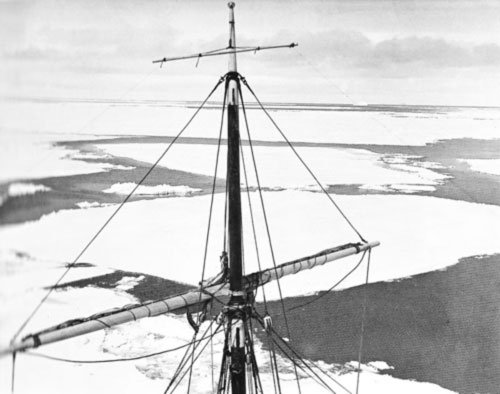
“The pack extended in all directions as far as the eye could reach.”
— Ernest Shackleton
“The pack extended in all directions as far as the eye could reach.”
— Ernest Shackleton

“Wild shot a young Ross seal on the floe, and we manoeuvred the ship alongside. Hudson jumped down, bent a line on to the seal, and the pair of them were hauled up. The seal was 4 ft. 9 in. long and weighed about ninety pounds. He was a young male and proved very good eating, but when dressed and minus the blubber made little more than a square meal for our twenty-eight men, with a few scraps for our breakfast and tea. The stomach contained only amphipods about an inch long, allied to those found in the whales at Grytviken.”
— Ernest Shackleton, South

“Large numbers of bergs, mostly tabular in form, lay to the west of the islands, and we noticed that many of them were yellow with diatoms.”
— Ernest Shackleton, South

Endurance entered the pack in earnest at latitude 59˚ 46″ S, longitude 18˚ 22″ W; 11 December 1914.
“The white moth to the closing bine,
The bee to the opened clover,
And the gipsy blood to the gipsy blood
Ever the wide world over.
Ever the wide world over, lass,
Ever the trail held true,
Over the world and under the world,
And back at the last to you.
Out of the dark of the gorgio camp,
Out of the grime and the grey
(Morning waits at the end of the world),
Gipsy, come away!
The wild boar to the sun-dried swamp,
The red crane to her reed,
And the Romany lass to the Romany lad,
By the tie of a roving breed.
The pied snake to the rifted rock,
The buck to the stony plain,
And the Romany lass to the Romany lad,
And both to the road again.
Both to the road again, again!
Out on a clean sea-track —
Follow the cross of the gipsy trail
Over the world and back!
Follow the Romany patteran
North where the blue bergs sail,
And the bows are grey with the frozen spray,
And the masts are shod with mail.
Follow the Romany patteran
Sheer to the Austral Light,
Where the besom of God is the wild South wind,
Sweeping the sea-floors white.
Follow the Romany patteran
West to the sinking sun,
Till the junk-sails lift through the houseless drift.
And the east and west are one.
Follow the Romany patteran
East where the silence broods
By a purple wave on an opal beach
In the hush of the Mahim woods.
“The wild hawk to the wind-swept sky,
The deer to the wholesome wold,
And the heart of a man to the heart of a maid,
As it was in the days of old.”
The heart of a man to the heart of a maid —
Light of my tents, be fleet.
Morning waits at the end of the world,
And the world is all at our feet!”
— Rudyard Kipling, 1904

Showing an overview of the Southern Continent, and positions of the Ross and Weddell Seas.
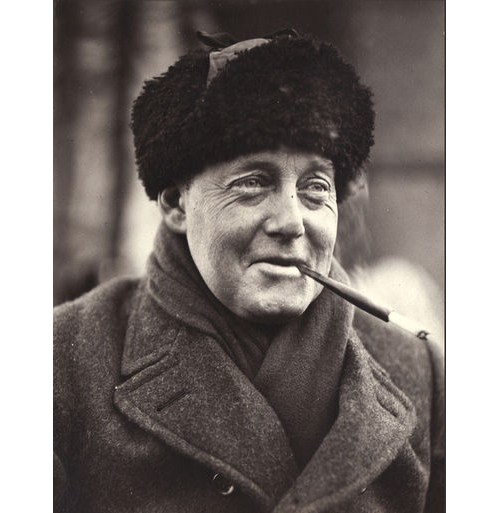
“Sir Daniel was the grandson of the other more illustrious Sir Daniel Gooch (1816-1889), the great railway engineer of some considerable genius who designed over 60 different classes of steam locomotives, and was responsible for laying the first ever Trans-Atlantic telegraph cable between Great Britain and America.
Gooch left the Expedition at South Georgia on Thursday 3rd December 1914. His home, Hylands House, had been requisitioned as a temporary war hospital and returned home to England to help with the supervision of its conversion. He funded the medical equipment himself, and the 190 bed hospital between 14th August 1914 and early 1919, treated over 1500 war wounded patients. Shackleton wrote ‘We all regretted losing his cheery presence when we headed for the South.’
Gooch was drafted in as a last minute substitute. Gooch’s qualifications for the job was that he was an expert breeder of Greyhounds and for years had followed the hunt. He sailed with the dogs on the La Negra from Liverpool on Monday 26th October 1914 bound for Buenos Aires, where he signed on board the Endurance as an able seaman.”
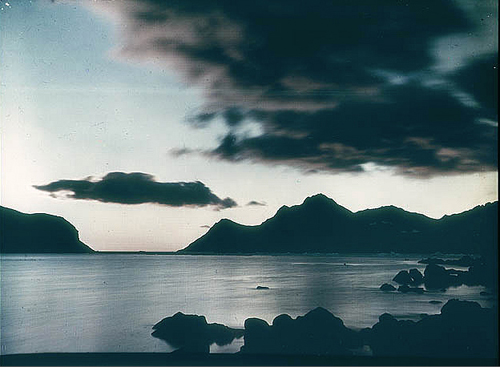
“We steamed from Cumberland Bay on 5 December 1914, after bidding adieu to our good friends, and Rasmussen highly excited by drowning his sorrows, accompanied us some distance in his motor launch. Aheading, circling, and sterning it, in a most ludicrous and amusing fashion. MacDougall could be seen, the last figure, waving us bon voyage till we rounded Mount Dusie and headed for the open sea and the south.”
— Frank Hurley
“What thoughts are ours, setting out thus at such a time, with no chance of news from dear ones at home who are passing through the greatest national crisis of modern times. What may we expect to learn in our return? The map of Europe may be greatly altered, but God grant that England may stand where she is this day and that all those dear to us may be spared from any privations or suffering.”
— Thomas Orde-Lees
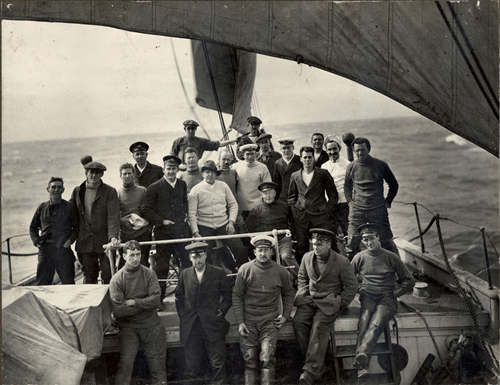
 Shackleton.