Strong likeness to stage scenery

“[The carpenter] fitted the mast of the Stancomb Wills fore and aft inside the James Caird as a hog-back and thus strengthened the keel with the object of preventing our boat ‘hogging’—that is, buckling in heavy seas. He had not sufficient wood to provide a deck, but by using the sledge runners and box lids he made a framework extending from the forecastle aft to a well. It was a patched-up affair, but it provided a base for a canvas covering.

“We had a bolt of canvas frozen stiff, and this material had to be cut and then thawed out over the blubber stove, foot by foot, in order that it might be sewn into the form of a cover.

“When it had been nailed and screwed into position it certainly gave an appearance of safety to the boat, though I had an uneasy feeling that it bore a strong likeness to stage scenery, which may look like a granite wall and is in fact nothing better than canvas and lath.”

— Ernest Shackleton, South
Posted in Shackleton | Comments Off on Strong likeness to stage scenery

In the boat

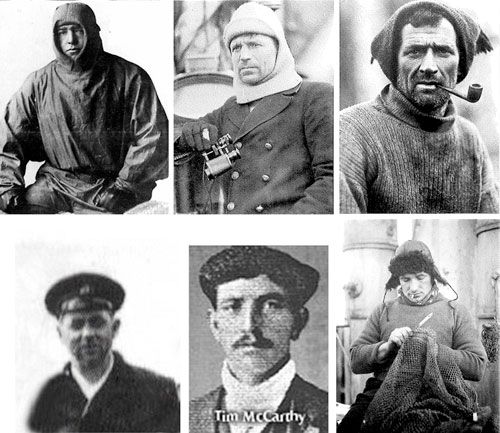
top row: Shackleton, Worsley, Crean; bottom row: McNeish, McCarthy, Vincent

top row: Shackleton, Worsley, Crean; bottom row: McNeish, McCarthy, Vincent

“There is a party of 6 going to Georgia in the Caird. The party includes:

Sir Ernest
Skipper
Creen
Macnish
McCarthy
Vincent.”

— Harry McNeish

Posted in Images, Other Voices | Comments Off on In the boat

Add nothing to the risks

“A boat party might make the voyage and be back with relief within a month, provided that the sea was clear of ice and the boat survive the great seas. […] The hazards of a boat journey across 800 miles of stormy ocean were obvious, but I calculated that at worst the venture would add nothing to the risks of the men left on the island.

“I had at once, to tell Wild that he must stay behind, for I relied upon him to hold the party together while I was away, and, should our attempt…end in failure, to make the best of his way to Deception Island in the spring. I determined to take Worsley with me a I had a very high opinion of his accuracy and quickness as a navigator.”

— Ernest Shackleton, South

Posted in Shackleton | Comments Off on Add nothing to the risks

Three possible objectives

map_abandonedship

“There were three possible objectives. The nearest of these was Cape Horn, the island of Tierra del Fuego—”Land of Fire,” which lay about 500 miles to the northwest. Next was the settlement of Port Stanley in the Falkland Islands, some 550 miles very nearly due north. Finally there was South Georgia, slightly more than 800 miles to the northeast. Though the distance to South Georgia was more than half again as far as the journey to Cape Horn, weather conditions made South Georgia the sensible choice.

“An easterly current, said to travel 60 miles a day, prevails in the Drake Passage, and almost incessant gales blow in the same direction. To reach either Cape Horn or the Falkland Islands would mean beating to windward against both of these colossal forces; it was enough to dare a 22-foot boat on these storm-wracked waters without trying to drive her to windward. En route to South Georgia, on the other hand, the prevailing winds would be generally astern—at least in theory.”

— Alfred Lansing, Endurance

Posted in Images, Other Voices | Comments Off on Three possible objectives

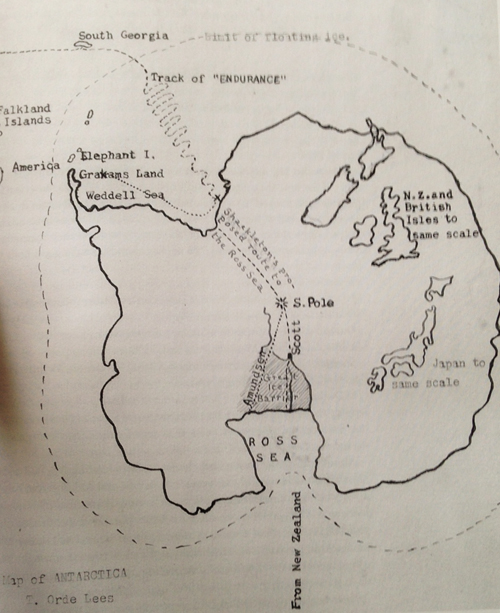
Another planet

Map drawn by Thomas Orde-Lees in 1930

Map drawn by Thomas Orde-Lees in 1930

“We were, in a world of our own, we had only ourselves to look to, and the world was as completely cut off from us as though we had come from another planet. I have experienced a good many strange things in my time, but this sensation of detachment from the living world was one of the most memorable.”

— Frank Worsley

Posted in Images, Other Voices | Comments Off on Another planet

The promise was not redeemed

“The icy fingers of the gale searched every cranny of our beach and pushed relentlessly through our worn garments and tattered tents. The snow, drifting from the glacier and falling from the skies, swathed us and our gear and set traps for our stumbling feet. The rising sea beat against the rocks and shingle and tossed fragments of floe ice within a few feet of our boats.

“Once during the morning the sun shone through the racing clouds and we had a glimpse of blue sky; but the promise of fair weather was not redeemed. The consoling feature of the situation was that our camp was safe. We could endure the discomforts, and I felt that all hands would be benefited by the opportunity for rest and recuperation.”

— Ernest Shackleton, South

Posted in Shackleton | Comments Off on The promise was not redeemed

Blizzard life

“Skinning [penguins] with our already partially frostbitten hands was painful work, for to bare the hand for a very few minutes in such a blizzard means almost certain frost-bite. We sought such shelter as we could find behind rocks and so on, but it was only the warmth of the dead penguins that saved our hands.

“The blizzard fairly raged. No-one got up who hadn’t got to. I had to as I was cook of the day for my tent. My tent-mates merely lay under their covering of snow, buttoned down tight in their sleeping bags, and I ministered to their gastronomic needs as best I could.

“I took our hoosh to the tent in an old saucepan without a handle, and duly doled it out to my now-submerged comrades. When I got there the hoosh was cold—usual complaints! How ungrateful some people can be when one is doing one’s best for them can best be found out on a jaunt such as ours.

“The strength of the wind may be judged by the fact that the Dudley Docker, on the beach, was blown completely round, and she is a heavy boat.”

— Thomas Orde-Lees

Posted in Other Voices | Comments Off on Blizzard life

Evil-smelling yellow mud

“The heat of our bodies soon melted the snow and refuse beneath us, and the floor of the tent became an evil-smelling yellow mud. The snow drifting from the cliff above us weighted the sides of the tent, and during the night a particularly stormy gust brought our little home down on top of us. We stayed underneath the snow-laden cloth till the morning, for it seemed a hopeless business to set about re-pitching the tent amid the storm that was raging in the darkness of the night.”

– Ernest Shackleton, South

Posted in Shackleton | Comments Off on Evil-smelling yellow mud

Rough, bleak and inhospitable

“The spit was by no means an ideal camping ground; it was rough, bleak and inhospitable – just an acre or two of rock and shingle, with the sea foaming around it except where the snow slope, running up to a glacier, formed the landward boundary.

“We were suffering from bad salt-water boils. Our wrists, arms and legs were attacked. Apparently this infliction was due to constant soaking with sea water, the chafing of wet clothes, and exposure.

“But some of the larger rocks provided a measure of shelter from the wind, and as we clustered round the blubber stove, with the acrid smoke blowing into our faces, we were quite a cheerful company.

“After all, another stage of the homeward journey had been accomplished and we could afford to forget for an hour the problems of the future.

“We ate our evening meal while the snow drifted down from the surface of the glacier, and our chilled bodies grew warm. Then we dried a little tobacco at the stove and enjoyed our pipes before we crawled into our tents.”

– Ernest Shackleton, South

Posted in Shackleton | Comments Off on Rough, bleak and inhospitable

Its own climate

“Elephant Island…is really just a half-submerged mountain massif with an ice sheet on its back. It has its own climate, featuring the worst aspects of the sea, the mountain world, and high latitudes.”

— Roland Huntford, Shackleton

“The ferocity of the land apparently spawned similarly forbidding weather. For some strange meteorological reason, savage, tornado-like downdrafts periodically swooped down from the heights above and fairly exploded when they struck the water, whipping the seas close inshore into a frenzy of spindrift and froth. Hussey thought they were the ‘wiliwaws,’ sudden bursts of wind peculiar to coastal areas in polar regions. It was one of those, apparently, that had caught the Docker the morning before.”

— Alfred Lansing, Endurance

“Such a wild and inhospitable coast I have never beheld. Yet there is a profound grandeur about these savage cliffs with the drifting snow and veiling clouds. We sheltered till the other boats came up in the lee of a vast headland, black and menacing, that rose from a seething surf, 1200 feet about our heads, and so sheer as to have the appearance of overhanging. Down the face streamed rivulets of snow that being caught by the hurricane blasts sweeping down an adjacent gorge, were whirled in blinding eddies mingling with the spindrift of the sea. I thought of those lines of [Robert] Service‘s: A land of savage grandeur / That measures each man at his worth.

— Frank Hurley

Posted in Other Voices | Comments Off on Its own climate