Don’t look back

“In steering a small boat before a heavy gale, don’t look back, it may disconcert you. Fix your eye with a glassy glare on a cloud or breaking sea right ahead & keep her straight, if you can. When you hear a roaring Bull of Bashan with a wet nose galloping up behind you, keep your head well forward & your shoulders hunched up to your ears—till you get it.”

— Frank Worsley

Posted in Other Voices | Comments Off on Don’t look back

The particular hell of the moment

“…life was reckoned in periods of a few hours, or possibly only a few minutes—an endless succession of trials leading to deliverance from the particular hell of the moment.

“…within each watch there were a number of subdivisions: the time at the helm—eighty eonic minutes…

“Again and again the cycle was repeated until the body and the mind arrived at a state of numbness in which the frenzied antics of the boat, the perpetual cold and wet came to be accepted almost as normal.”

— Alfred Lansing, Endurance

Posted in Other Voices | Comments Off on The particular hell of the moment

One hand for yourself & one for the King

“So we all took it in turns to crawl out with an axe & chop it off. What a job! The boat leaping & kicking like a mad mule & a great fifteen inch thick slippery casing of ice over her like a turtle back with slush all over where the last sea was freezing. First you chopped a handhold, then a kneehold & then went on chopping ice for dear life while an occasional sea leapt over you. After four or five minutes you slid back into the boat — fed up or frostbitten & the next man took up the work, in doing which it was “One hand for yourself & one for the King” because if a man had gone overboard then it would have been goodbye.”

— Frank Worsley

Posted in Other Voices | Comments Off on One hand for yourself & one for the King

Wonderful

“The spray was now freezing on the canvas as it fell.”

— Roland Huntford

“It possessed a notable advantage from one point of view. The water ceased to drop and trickle from the canvas, and the spray came in solely at the well in the after part of the boat.”

— Ernest Shackleton, South

“We could hardly believe that anything so wonderful had happened.”

— Frank Worsley

Posted in Other Voices, Shackleton | Comments Off on Wonderful

Sea anchor

“A sea-anchor is a cone-shaped canvas bag attached by a line at its mouth to the bows. The apex, which has a small hole, points away from the ship, and the effect is to act as a drag in the water, around which the vessel swings to keep head to wind. This is essential for a small boat to survive in a seaway.”

— Roland Huntford, Shackleton

Posted in Other Voices | Comments Off on Sea anchor

We came to know every one of the stones by sight and touch

“The boulders that we had taken aboard for ballast had to be shifted continually in order to trim the boat and give access to the pump, which became choked with hairs from the moulting sleeping bags and finneskoe. The four reindeerskin sleeping bags shed their hair freely owing to the continuous wetting, and soon became quite bald in appearance. The moving of the boulders was weary and painful work. We came to know every one of the stones by sight and touch, and I have vivid memories of their angular peculiarities even today. They might have been of considerable interest as geological specimens to a scientific man under happier conditions. As ballast they were useful. As weights to be moved about in cramped quarters they were simply appalling. They spared no portion of our poor bodies.”

— Ernest Shackleton, South

Posted in Shackleton | Comments Off on We came to know every one of the stones by sight and touch

If a boat is overweighted, she jerks

“If a boat is overweighted, she jerks, will not sail fast & does not heel away from the wind & so constantly takes seas over her & is at all times wet… If ballast is too low it makes vessels stiff & they roll heavily & jerkily. Again if it is spread all along the bottom as in the Caird instead of being piled up in the centre, it makes her pitch very heavily.”

— Frank Worsley

Posted in Other Voices | Comments Off on If a boat is overweighted, she jerks

Wicklike action

“All of them were dressed more or less the same way—heavy wool underwear, woolen trousers, a thick, loose sweater, with a pair of light gabardine Burberry overalls on the outside. Their heads were covered with knitted, woolen helmets and Burberry outer helmets, tucked in at the neck. On their feet they wore two pairs of socks, a pair of ankle-high felt boots and finneskoes—reindeer-skin boots with the hair side out, though every trace of hair had long since worn off, leaving them bald and limp. There was not a set of oilskins on board.

“Such clothing was intended for wear in intense, dry cold—not on board a pitching, spray-drenched boat. Here it had an almost wicklike action, soaking up every ice drop until the saturation point was reached, then maintained.”

— Alfred Lansing, Endurance

Posted in Other Voices | Comments Off on Wicklike action

Merry jest of guesswork

“Navigation is an art, but words fail to give my efforts a correct name. Dead reckoning or DR—the seaman’s calculation of courses and distance—had become a merry jest of guesswork… The procedure was: I peered out from our burrow—precious sextant cuddled under my chest to prevent seas falling on it. Sir Ernest stood by under the canvas with chronometer pencil and book. I shouted “Stand by,” and knelt on the thwart—two men holding me up on either side. I brought the sun down to where the horizon ought to be and as the boat leaped frantically upward on the crest of a wave, snapped a good guess at the altitude and yelled, “Stop,” Sir Ernest took the time, and I worked out the result… My navigation books had to be opened page by page till the right one was reached, then opened carefully to prevent utter destruction.”

— Frank Worsley

Posted in Other Voices | Comments Off on Merry jest of guesswork

The Drake Passage

“Thus they had just crept over the line separating the ‘Raving Fifties’ from the ‘Screaming Sixties,’ so called because of the weather that prevails there.

“This, then, was the Drake Passage, the most dreaded bit of ocean on the globe—and rightly so.”

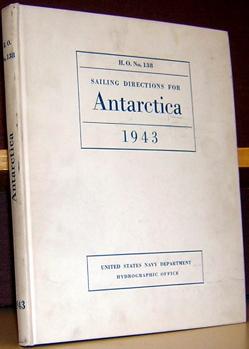
sailingdirections1943

“In the prosaic, often studiously understated language of the U.S. Navy’s Sailing Directions for Antarctica, these winds are described categorically: ‘They are often of hurricane intensity and with gust velocities sometimes attaining to 150 to 200 miles per hour. Winds of such violence are not known elsewhere, save perhaps within a tropical cyclone.’

“Also in these latitudes, as nowhere else on earth, the sea girdles the globe, uninterrupted by any mass of land. Here, since the beginning of time, the winds have mercilessly driven the seas clockwise around the earth to return again to their birthplace where they reinforce themselves of one another.

“The waves thus produced have become legendary among seafaring men. They are called Cape Horn Rollers or ‘graybeards.'”

— Alfred Lansing, Endurance

Posted in Images, Other Voices | Comments Off on The Drake Passage